

- Why Outgassing Damages Optical Systems: The Three-Step Process
- Four Types of Optical Damage: From Reversible to Permanent
- Material Comparison: Low-Outgassing Epoxy vs. Low-Outgassing Silicone
- Qualification Standards: ASTM E595, ASTM E1559, and the NASA GSFC Database
- Verified Product Reference Guide
- Lifecycle Outgassing Control: From Material Selection to TVAC Acceptance
- Technical Summary
- Frequently Asked Questions
In aerospace manufacturing, the long-term integrity of optical systems depends critically on adhesive chemistry. Molecular contamination from outgassing materials — adhesives, sealants, and potting compounds — is a documented cause of optical degradation in space hardware, affecting image resolution, sensor sensitivity, and coating durability. Selecting the right low-outgassing material requires understanding which material class best matches the specific optical application, thermal environment, and qualification standard.
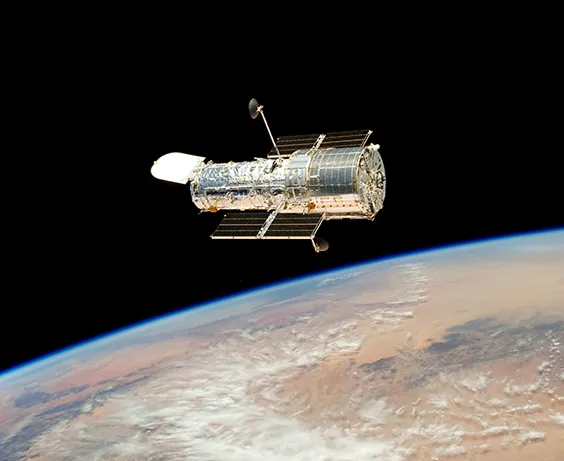
Source: Internet
See also: Epoxy Adhesive & Industrial Epoxy: Complete Knowledge Guide · Potting Compounds: How to Choose · Potting & Encapsulation Solutions
Why Outgassing Damages Optical Systems: The Three-Step Process
The outgassing pathway from adhesive chemistry to optical failure follows a well-characterized three-step sequence, documented in NASA and peer-reviewed literature. Throughout all three steps, the space environment — near-vacuum pressure and wide thermal excursions — acts as a continuous amplifying condition.
Step 1 — Volatile release under thermal-vacuum stress: Adhesives and elastomers contain residual volatile species: unreacted monomers, processing solvents, and — in standard silicones — low-molecular-weight cyclic siloxanes (D3 through D6) that are inherent to the polymer matrix prior to and after cure. Under near-vacuum conditions (≤7×10⁻³ Pa) and thermal excursions from solar heating or orbital cycling, these species gain sufficient kinetic energy to escape the material matrix. Outgassing is not limited to in-orbit service: it occurs during ground-level thermal-vacuum (TVAC) testing, launch depressurization, and cleanroom assembly.
Step 2 — Migration and cold-surface condensation: Released molecules migrate along thermal and pressure gradients. In optical payloads, lenses, detector windows, and mirror surfaces are consistently the coolest components, making them preferential condensation sites. The resulting molecular film reduces optical transmission and introduces scattering. Deposition rate is directly affected by surface temperature — cooler surfaces accumulate contamination faster, and the vacuum environment eliminates atmospheric scattering that would otherwise impede molecular transport.
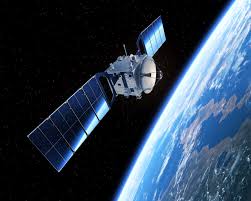
Source: Optical Payloads and Space Optical Remote Sensing | Avantier
Step 3 — Photochemical deposition in the thermal-vacuum environment: Once condensed, organic films are exposed to the combined space environment: solar UV and vacuum-UV (VUV) radiation, charged-particle bombardment, high temperatures from direct solar irradiation, and near-vacuum pressure. UV and VUV radiation are the primary triggers for photochemical deposition — UV-induced polymerization that converts the condensed organic film into a crosslinked polymer layer. The thermal-vacuum environment further amplifies this process: vacuum removes atmospheric oxygen, which would otherwise quench radical chain reactions; elevated surface temperatures from solar heating increase photochemical reaction kinetics according to Arrhenius relationships. The resulting polymer layer typically has a Coefficient of Thermal Expansion (CTE) differing significantly from the underlying optical coating. Subsequent thermal cycling generates mechanical stress leading to micro-cracking or delamination of the optical coating — damage confirmed as irreversible in peer-reviewed literature (Acta Astronautica, 2018; NASA NTRS #20090040762).
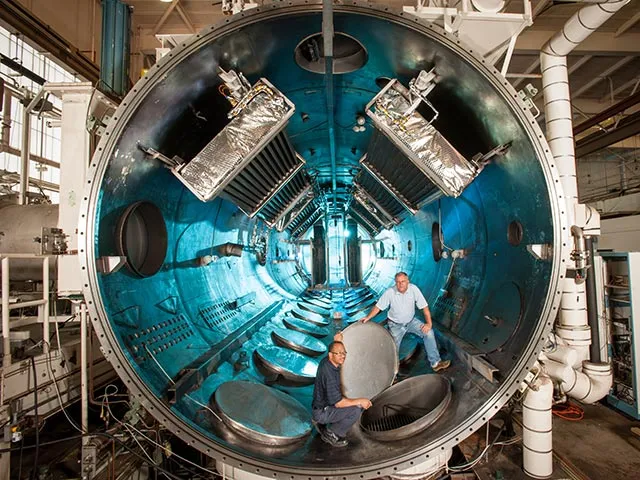
Source: Thermal Vacuum Facilities – NASA
Four Types of Optical Damage: From Reversible to Permanent
|
Damage Type |
Physical Mechanism |
Functional Consequence |
Reversible? |
|
Lens clouding |
Condensed VOC film scatters incident light *VOC: Volatile Organic Compound |
Reduced image contrast and spatial resolution |
Partially — if detected early |
|
Spectral shift |
Condensed film selectively absorbs UV or IR wavelengths |
Loss of band-specific sensitivity; calibration drift |
Partially — if detected early |
|
SNR degradation |
Residue acts as an unintended filter on the detector die |
Increased electronic noise; reduced dynamic range |
Conditional |
|
Coating delamination |
CTE mismatch between polymerized film and optical coating under thermal cycling |
Permanent structural damage to optical surfaces |
No |
Sources: NASA NTRS #20090040762; Acta Astronautica (2018); ASTM E595 background literature.
The first two damage types may be partially reversible through thermal bake-out if detected early. Coating delamination is irreversible.
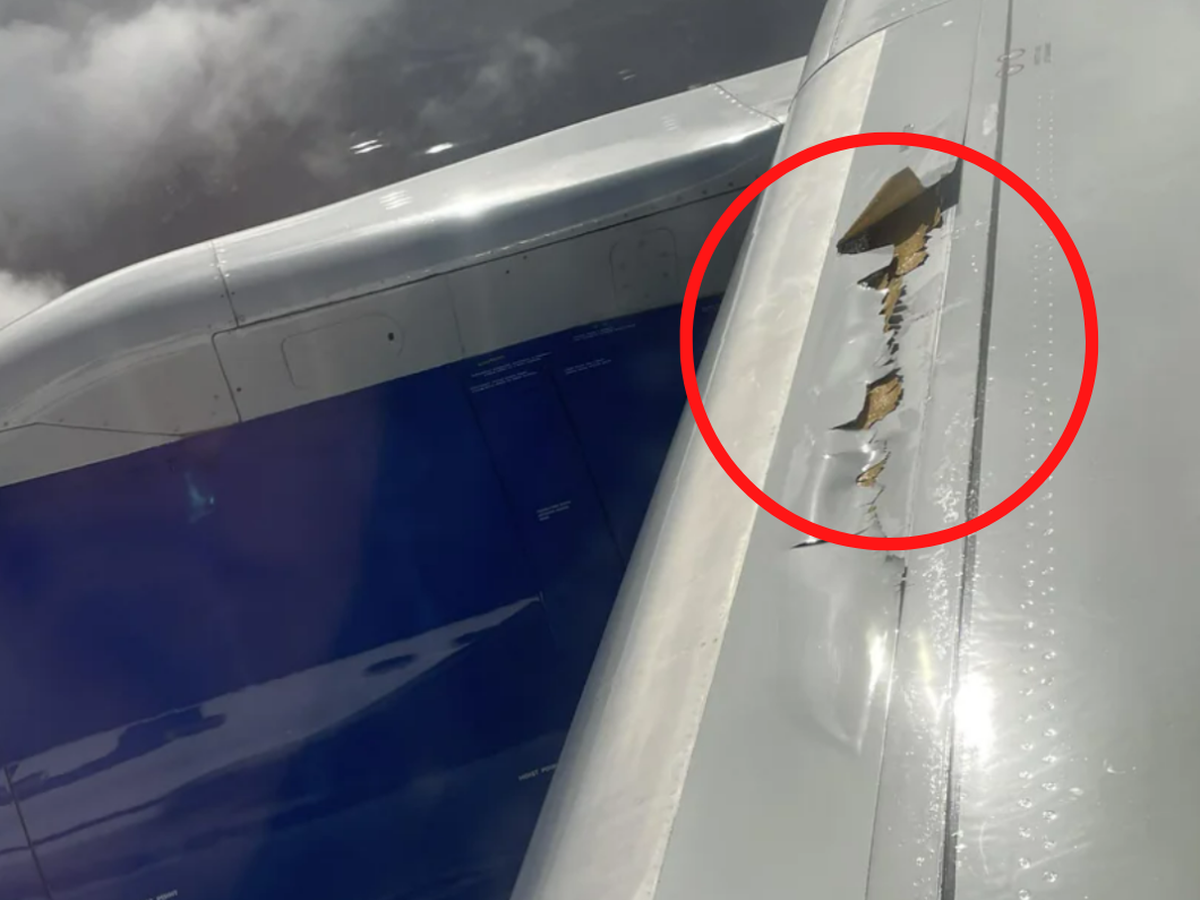
Source: Internet
Refer to this for more information about coating.
Standard silicone is one of the most significant outgassing sources in electronic and optical assemblies, primarily due to the presence of cyclic siloxanes (D3–D6) during and after the curing process. These low-molecular-weight compounds have relatively high vapor pressure and volatilize readily under vacuum. Standard acetoxy-cure condensation systems additionally release acetic acid during cure, which can corrode metallic surfaces and PCB traces.
However, when rigorously purified and correctly formulated, silicone becomes technically appropriate — and in some applications, irreplaceable — for aerospace optical hardware. This is the Silicone Paradox: the same material class that poses the greatest contamination risk, when processed to aerospace grade, offers a thermal range and mechanical flexibility that no other widely available adhesive material can match.
Aerospace-grade low-outgassing silicones address the contamination risk through two mechanisms:
- Molecular purification: Post-polymerization removal of D3–D6 cyclic siloxane fragments and low-molecular-weight linear species through stripping or solvent extraction, reducing volatile content at the source before the material reaches the customer
- Addition-cure chemistry: Platinum-catalyzed two-part systems that cure without producing volatile byproducts — contrasted with condensation-cure systems (acetoxy, oxime) that release acetic acid or other small molecules during crosslinking
Material Comparison: Low-Outgassing Epoxy vs. Low-Outgassing Silicone
|
Criterion |
Low-outgassing epoxy |
Low-outgassing silicone (space-grade) |
|
Outgassing (baseline after full cure) |
Inherently low — highly crosslinked network limits free volatile species |
Low only after rigorous molecular purification to remove D3–D6 content |
|
Mechanical strength |
High; suited to structural and direct optical bonding |
Low to moderate; suited to flexible sealing and potting joints |
|
Useful temperature range |
Tg-dependent; typically −60°C to ~200°C (varies by formulation) |
−115°C to 260°C continuously (Momentive Siltrust™ RTV566; TDS HCD-RTV566 Rev.2021) |
|
CTE mismatch tolerance |
Limited; rigid joint transmits thermal stress to optical interface |
High; elastic deformation accommodates mismatch across thermal cycles |
|
Cryogenic performance |
Brittleness increases typically below −60°C (formulation-dependent) |
Remains elastomeric at cryogenic temperatures |
|
Direct optical bonding |
Preferred — minimal creep, high dimensional stability |
Not typically used for precision optical alignment bonding |
|
Sealing / gasketing |
Not suited |
Primary application |
|
Potting electronics |
Suitable where high-Tg stability is required |
Preferred where severe thermal cycling or vibration occurs |
|
Vibration damping |
Limited |
Preferred |
|
Post-cure requirement |
Recommended for critical optical applications |
Required to achieve aerospace-grade outgassing qualification |
Watch a video about silicone for Satellites & Space Applications below.
Qualification Standards: ASTM E595, ASTM E1559, and the NASA GSFC Database
|
Standard |
Test conditions |
Pass thresholds |
Scope and limitation |
|
ASTM E595 |
125°C; <7×10⁻³ Pa (<5×10⁻⁵ torr); 24 hours; collector plate at 25°C |
TML ≤ 1.0%; CVCM ≤ 0.1%; WVR measured optionally |
Screening test only. Per ASTM E595 §5.2: “The 24h test time does not represent actual outgassing from years of operation.” Test pressure (~5×10⁻⁵ torr) is also orders of magnitude higher than actual LEO vacuum (~10⁻⁷ to 10⁻¹¹ torr). Use as qualification floor, not mission-life guarantee. |
|
ASTM E1559 |
Multiple temperatures and time intervals; records outgassing rate as function of time |
No single pass/fail — provides kinetic rate data |
For sensitive optical payloads and long-duration missions. Enables modeling of contamination accumulation across mission lifetime. Recommended when CVCM ≤ 0.01% is required. |
|
NASA GSFC Outgassing Database |
Compilation of ASTM E595 batch-level results tested at Goddard Space Flight Center |
“Low Outgassing” section: materials with TML ≤ 1.0% and CVCM ≤ 0.1% |
Reference tool only. Database disclaimer: “Use does not imply that a material is NASA approved.” Listing confirms one batch was tested — not a guarantee of current production batch performance. |
Or contact our expert team for free product recommendations for your applications.
Related reading: Industrial Glass Adhesive: Ultimate Guide for Manufacturers
Why CVCM matters more than TML for optical systems: TML includes the release of absorbed water vapor, which may not condense on optical surfaces under all conditions. CVCM specifically measures the fraction of outgassed material that deposits on a cooled collector plate at 25°C — directly modeling the condensation behavior that causes lens clouding and spectral shift. For optical qualification, CVCM is the operationally critical metric.
Verified Product Reference Guide
The products listed below are included as technical reference examples based on publicly available documentation from their respective manufacturers. Engineers must verify current batch-level ASTM E595 data directly from the manufacturer or the NASA GSFC Outgassing Database before specifying any material for flight hardware. Batch-to-batch variation in outgassing performance is documented and should not be assumed uniform.
Low-outgassing silicone — verified products
|
Product |
Cure system |
ASTM E595 status |
Published TML / CVCM |
Typical aerospace application |
|
Momentive Siltrust RTV566 |
Condensation, 2-part |
Compliant |
Passes TML ≤ 1.0%, CVCM ≤ 0.1% |
Encapsulation, sealing, potting; −115°C to 260°C continuously |
|
Momentive Siltrust RTV567 |
Condensation, 2-part, flowable |
Compliant |
Passes TML ≤ 1.0%, CVCM ≤ 0.1% |
Potting electronics; optical equipment sealing |
Struggling to find a suitable material for your application?
Low-outgassing epoxy – Application Decision Guide
|
Application |
Primary requirement |
Recommended material |
|
Precision optical bonding (lens-to-barrel, prism-to-bench) |
Dimensional stability, minimal creep, high bond strength |
Low-outgassing epoxy |
|
Sealing and gasketing of optical housings |
CTE accommodation, wide thermal range, elasticity |
Low-outgassing silicone |
|
Potting electronics with severe thermal cycling |
Flexibility, cryogenic and high-temp performance |
Low-outgassing silicone |
|
Potting electronics with stable thermal conditions |
High-Tg structural stability |
Low-outgassing epoxy suitable |
|
Vibration damping around sensor arrays |
Elastic deformation, strain relief |
Low-outgassing silicone |
|
Cryogenic optical assembly (below −60°C) |
Elastomeric performance at low temperature |
Low-outgassing silicone |
Note: In complex optical payloads, both material classes are frequently used in complementary roles within the same assembly — epoxy for structural/optical joints, silicone for sealing and vibration management.
Lifecycle Outgassing Control: From Material Selection to TVAC Acceptance
Correct material selection is necessary but not sufficient. The following process disciplines apply to both material families across the full project lifecycle:
Stage 1 — Material selection (design phase): Specify materials with verified ASTM E595 batch data. Verify TML and CVCM from the specific production batch datasheet, not the product family certificate. Batch-to-batch variation exists and is documented. Cross-reference the NASA GSFC Outgassing Database for any available batch-level records.
Stage 2 — Cleanroom assembly: Surface contamination from fingerprint oils, cutting lubricants, and airborne particulates constitutes an independent outgassing source unrelated to adhesive chemistry. Cleanroom protocol does not substitute for correct material selection — both controls are required simultaneously.
Stage 3 — Post-cure bake-out: A controlled thermal bake-out at 50°C–100°C in a low-pressure or inert atmosphere for 24–72 hours drives off residual volatile species from the cured adhesive before optical sealing. This step is supplementary to material qualification — it is not a remediation for non-compliant material grades.
Stage 4 — TVAC acceptance testing: Thermal-vacuum testing of the final assembly verifies outgassing performance under representative conditions and detects unexpected burst outgassing phases at temperature transitions. TVAC results at the assembly level may differ from material-level ASTM E595 data due to joint geometry, cure conditions, and combined outgassing from multiple materials in proximity.
Related reading: 3M Low Outgassing Tape 6670 for Aerospace Cleanroom Applications · 3M Ultra-Pure Viscoelastic Damping Polymer 242NR02 · Epoxy Resin and Its Industrial Applications
Technical Summary
Both low-outgassing epoxy and low-outgassing silicone are technically valid material options for aerospace optical systems, provided they are correctly qualified, applied, and processed. The selection between them is determined by the mechanical and thermal demands of the specific application. Neither is universally superior: epoxy is the appropriate choice where structural rigidity and dimensional stability are required; silicone is the appropriate choice where thermal range, flexibility, and CTE accommodation are required.
No material selection eliminates contamination risk entirely. ASTM E595 compliance establishes a qualification floor for the material in its cured state; it does not model mission-lifetime contamination accumulation, nor does it replicate actual on-orbit vacuum conditions (LEO: ~10⁻⁷ to 10⁻¹¹ torr), which are orders of magnitude lower than the test condition of 5×10⁻⁵ torr. For sensitive optical payloads, engineers should layer qualification methods: ASTM E595 for initial material screening, ASTM E1559 for kinetic data on long-duration missions, and assembly-level TVAC testing for final acceptance.
Frequently Asked Questions
Q1: Does ASTM E595 compliance guarantee no optical contamination?
No. Per ASTM E595 §5.2, the 24-hour test “does not represent actual outgassing from years of operation.” The test is a comparative screening tool with thresholds (TML ≤1.0%, CVCM ≤0.1%) historically used by NASA as a minimum acceptance criterion. Additionally, the test pressure of ~5×10⁻⁵ torr is orders of magnitude higher than actual on-orbit vacuum. For sensitive optical payloads and multi-year missions, ASTM E1559 testing and ultra-low outgassing grades (CVCM ≤0.01%) provide more operationally relevant qualification data.
Q2: Can post-cure bake-out bring standard silicone to ASTM E595 compliance?
Not reliably. Standard silicones contain cyclic siloxane fractions (D3–D6) that are structurally integrated into the polymer network. Thermal bake-out can reduce surface-resident volatiles but cannot remove low-molecular-weight cyclic species to the same degree as molecular purification performed during manufacturing. Space-grade materials are purified before formulation; bake-out is a supplementary step applied to an already-qualified material, not a remediation for unqualified grades.
Q3: Why is CVCM more critical than TML for assessing optical contamination risk?
TML measures total mass loss, including water vapor released during the test. Water vapor does not condense on optical surfaces under all flight conditions. CVCM measures only the species that deposit on a collector plate held at 25°C — directly modeling the condensation behavior relevant to lenses, detector windows, and mirror surfaces. CVCM is therefore the operationally relevant threshold for optical contamination assessment.
Q4: Is ultra-low outgassing silicone (CVCM ≤0.01%) always necessary for optical applications?
Not in every case. Standard ASTM E595 compliance (CVCM ≤0.1%) is sufficient for many aerospace assemblies where the adhesive is not in direct proximity to exposed optical surfaces, or where mission duration is limited. Ultra-low outgassing grades are specified for ultra-sensitive instruments, long-duration missions, or applications where trace contamination would affect measurement accuracy.
Q5: What is the Silicone Paradox, and why does it matter for material selection?
Standard silicone is a primary source of outgassing contamination in space hardware due to cyclic siloxane (D3–D6) volatility. Yet properly purified, addition-cure silicone is one of very few commercially available materials that maintains functional elastomeric properties from cryogenic temperatures to over 250°C — a range that most epoxy or polyurethane systems cannot match. The paradox is that the material class most associated with contamination risk, when processed to aerospace grade at the molecular level, is also one of the most suitable for applications where thermal range and CTE accommodation are non-negotiable. Material grade — not material type — determines whether silicone is a contamination source or a contamination mitigation tool.
For product enquiries or technical consultation on low-outgassing material selection: Contact Prostech · View Adhesive Product Range · Sealant & Gasketing Solutions