

- What Causes Fogging in the First Place
- How SilFORT TAC2000 Works
- Where SilFORT TAC2000 Is Applied
- Key Takeaways of SilFORT TAC2000
- Frequently Asked Questions
- What causes fogging on a polycarbonate headlamp lens?
- How is anti-fog coating different from a hydrophobic coating?
- Is SilFORT TAC2000 the same as SilFORT UVHC5000?
- What test standard is used to validate automotive anti-fog coatings?
- Can SilFORT TAC2000 be used on ADAS sensor covers, not just headlamps?
- How thick is the SilFORT TAC2000 coating layer?
Polycarbonate (PC) is now the default material for automotive headlamp lenses, ADAS sensor covers, and front-end modules. It is lighter than glass, more impact-resistant, and easier to mold into complex shapes. But PC has one field problem most datasheets skip: internal fogging, which can be solved effectively using SilFORT TAC2000 – an advanced coating for PC and PMMA substrates.
When temperature and humidity shift inside a sealed headlamp housing or an ADAS cover, water vapor condenses on the inner PC surface. On a headlamp, that means reduced light output and a hazy look customers read as a defect. On an ADAS cover — a camera or LiDAR housing — condensation is a functional failure: it can cut sensor signal quality exactly when weather makes that sensor most necessary.

SilFORT TAC2000, is a thermal-cured anti-fog coating built specifically for PC and PMMA substrates. This technical overview is prepared by Prostech, covers how the coating works, how it performs under automotive-grade testing, and how it fits into a production process.
What Causes Fogging in the First Place
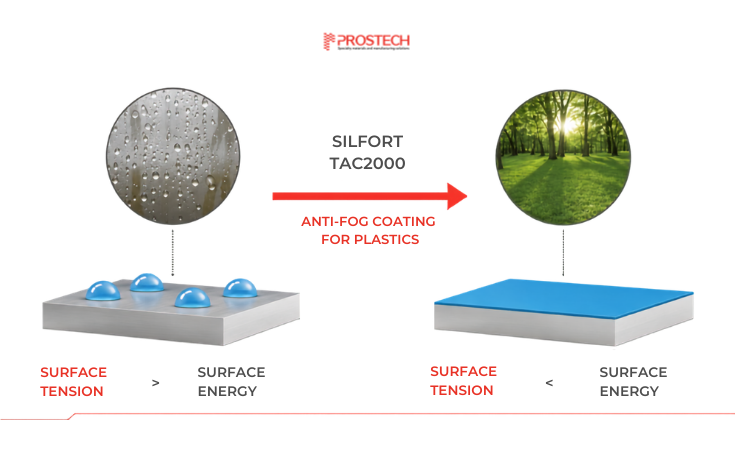
Fogging is visible condensation of water on a surface. Whether it appears as haze or stays invisible depends on the relationship between a surface’s surface tension and its surface energy.
- Surface tension greater than surface energy: the surface is hydrophobic. Water forms small, discrete droplets. Each droplet scatters incident light, and the surface reads as cloudy or hazy.
- Surface tension lower than surface energy: the surface is hydrophilic. Water spreads into a thin, continuous film instead of beading up. Light passes through largely undisturbed, so the surface stays visually clear even while wet.
SilFORT TAC2000 is built on this second principle. Instead of repelling water, it makes the surface hydrophilic enough that condensation cannot form into light-scattering droplets in the first place.
How SilFORT TAC2000 Works
SilFORT TAC2000 is a two-component, thermal-cured coating system for polycarbonate and PMMA. It creates a hydrophilic surface with a water contact angle below 30°. At that contact angle, water cannot organize into separate droplets — it spreads into a continuous, optically clear layer instead. That is what prevents the haze that would otherwise read as fog.
Physical Coating Properties and Application Parameters of SilFORT TAC2000
Key process parameters for engineers evaluating fit with an existing coating line:
- Mixing ratio (resin / hardener / solvent): 80/20 for spray coating (17% total solids); 80/20/30 for flow coating (13% total solids)
- Pot life: consume within 5 days after mixing resin and hardener
- Coating thickness: 2–8 µm
- Storage: raw components at 2–38°C; shelf life 12 months
Production Process Flow
TAC2000 fits into a defined thermal-cure process:
- Loading of parts
- Substrate cleaning — ionized air and IPA cleaning to remove surface contaminants
- Coating mix and filtration — resin, hardener, and a solvent such as methoxypropanol are combined, then filtered through a 5–8 µm pre-filter followed by a ≤1 µm gel absolute filter; the mixed coating is stored at 20–30°C
- Coating application — spray or flow coating, 2–8 µm target thickness, within the 5-day pot life window
- Ambient flash-off — 5–10 minutes at 20–30°C and 40±15% relative humidity
- Thermal curing — PC: 20 minutes at 100–120°C; PMMA: more than 30 minutes at 85–90°C
- Unloading and cool-down
Cure temperature can be adjusted for substrate sensitivity (10–60 minute range at 90–120°C). Alternative solvents — 1-methoxy-2-propanol, isopropanol, butyl acetate, or ketones such as MEK — may also be considered depending on process requirements.
Validated Performance of SilFORT TAC2000: GMW16508:2016 Test Results
SilFORT TAC2000 was evaluated against GMW16508:2016, the automotive test protocol for anti-fog coatings. Coating thickness for testing was ≥3 µm, cured 20 minutes at 120°C on a PC substrate. All results as below:
| Test Category | Test | Condition | Result | AF-Test (clear time) |
|---|---|---|---|---|
| Initial | Appearance | No haze or yellowing | Pass | — |
| Initial | Adhesion | Tape pull test | Pass | — |
| Initial | Condensation / initial steam | No visible condensation within 20s; 60°C water; <20 cm distance | Pass | 90 seconds |
| Durability | Heat test | 120°C / 10 days | Pass | 90 seconds |
| Durability | Humidity test | 60°C, 100% RH, 10 days | Pass | 30 seconds |
| Durability | Climate cycle | 14 days, cycling -30°C to 80°C, 95% RH | Pass | 90 seconds |
| Durability | Xenon weathering | SAE J2527; AF coating on back side, UVHC5000 on front side | Pass at 6,600 kJ/m² | 25 seconds |
| Durability | Natural weathering | SAE J576, Florida & Arizona | Pass, 3 years | 60 seconds |
Evaluation performed in laboratory. Real-world data may vary depending on application parameters and substrate.
Two points stand out. First, the coating passed a full durability battery: 10-day heat aging, 10-day humidity exposure, a 14-day thermal/humidity cycle spanning -30°C to 80°C, accelerated xenon weathering, and three years of outdoor exposure in two of the industry’s most demanding natural weathering environments. Second, anti-fog clear time stayed low and consistent across every stage — 25 to 90 seconds — meaning the anti-fog function did not degrade meaningfully after aggressive aging.
Xenon Weathering: Optical Stability Over Simulated Lifetime
In the SAE J2527 xenon weathering test, a PC panel (Lexan LS1) was built as a two-layer system: UVHC5000 on the top layer (facing the light source, for UV/weathering protection) and TAC2000 on the bottom layer (for anti-fog function on the interior-facing surface). This mirrors how the two coatings are deployed together in a real headlamp.
Across 6,600 kJ of xenon exposure:
- Haze stayed low, trending from roughly 0.5% to approximately 2.5%
- Yellowness Index stayed close to neutral, moving from slightly negative values to roughly +1.5
- Transmission stayed consistently in the 90–92% range
Anti-fog performance after the full 6,600 kJ exposure was evaluated against GMW16508 and passed. The coating system held both optical clarity and anti-fog function through the full simulated weathering cycle.
Real-World Validation: 36 Months of Natural Weathering
Beyond lab testing, TAC2000/UVHC5000 system is validated on fully assembled headlamp lenses, not just flat panels, under SAE J576 natural weathering in Florida and Arizona. UVHC5000 was applied to the front (outward-facing) side and TAC2000 to the back (inward-facing) side — the same construction used in a production headlamp.
After 36 months outdoors in both climates: high transparency, no visible haze, and TAC2000 continued to pass its anti-fog test. This validates performance at the assembly level, in real climate conditions, over a multi-year timeframe.
Where SilFORT TAC2000 Is Applied
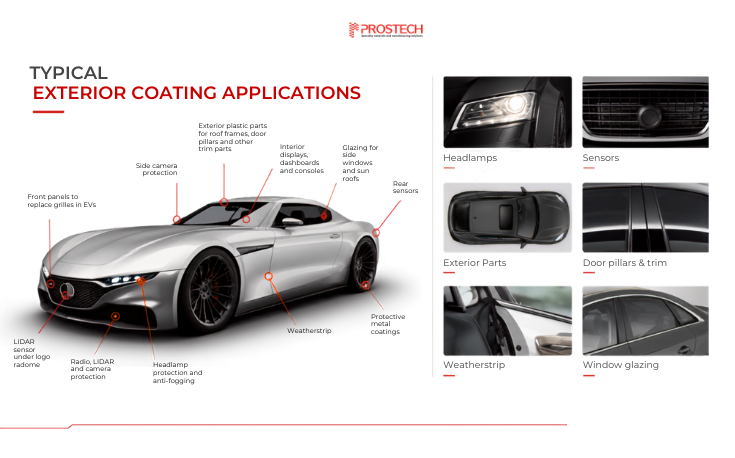
Automotive headlamp lenses — applied to the inside surface to prevent fogging in high-humidity conditions and maintain light output.
ADAS sensor covers — applied to the inside of covers protecting Advanced Driver Assistance Systems, to keep the device functioning reliably rather than losing signal clarity to internal condensation.
Key Takeaways of SilFORT TAC2000
- TAC2000 solves fogging through a hydrophilic surface mechanism (contact angle <30°), not a hydrophobic repellent approach — this is why it stays optically clear rather than just resisting water.
- It is a two-component, thermal-cured system compatible with PC and PMMA, with defined mixing ratios and pot life for spray or flow application.
- Performance is backed by a full GMW16508:2016 test battery — heat aging, humidity, climate cycling, xenon weathering, and 3-year natural weathering — with passing results at every stage.
- It has been validated at the fully assembled headlamp level, not only on flat coupons, in real outdoor climates over 36 months.
- It is typically deployed as a two-coating system: TAC2000 on the interior surface, paired with a weatherable hardcoat such as UVHC5000 on the exterior.
Frequently Asked Questions
What causes fogging on a polycarbonate headlamp lens?
Fogging is condensation — water vapor forming visible droplets that scatter light. It happens when the surface is hydrophobic (surface tension greater than surface energy), which causes water to bead into small droplets instead of spreading into a clear film.
How is anti-fog coating different from a hydrophobic coating?
A hydrophobic coating repels water into droplets, which scatter light and cause haze. SilFORT TAC2000 does the opposite: it creates a hydrophilic surface (water contact angle below 30°) so condensation spreads into a thin, continuous, optically clear film instead of forming droplets.
Is SilFORT TAC2000 the same as SilFORT UVHC5000?
No. They are two different, complementary coatings typically used together on the same headlamp lens: UVHC5000 is a weatherable hardcoat on the outward-facing side for UV and scratch protection; TAC2000 is applied to the inward-facing side for anti-fog performance.
What test standard is used to validate automotive anti-fog coatings?
SilFORT TAC2000 was evaluated against GMW16508:2016, an automotive anti-fog test protocol covering appearance, adhesion, condensation resistance, heat aging, humidity, climate cycling, xenon weathering, and natural weathering — with passing results reported at every stage.
Can SilFORT TAC2000 be used on ADAS sensor covers, not just headlamps?
Yes. ADAS sensor covers are confirmed to be among primary use case alongside headlamp lenses, applied to the inside surface to prevent condensation from degrading sensor signal clarity.
How thick is the SilFORT TAC2000 coating layer?
2–8 µm, depending on whether it is applied by spray or flow coating.