

Interest in PFAS-free alternatives is growing across the materials and electronics industry, as manufacturers evaluate surface protection options that do not rely on PFAS-based chemistry. One of Prostech’s partner brands, has developed a response to this shift: PFAS-Free, Hydrophobic Coatings for Glass. Built on tailored silicone (silane/siloxane) architecture, this coating platform is designed to provide hydrophobic and oleophobic surface protection without PFAS in the formulation.
This article summarizes the chemistry behind the coating, the preliminary performance data currently available, and the coating process used to apply it — with particular attention to its relevance for electronic display applications.
Silicone Chemistry as an Alternative to PFAS
Surface tension is a key property affecting how well a coating repels water, oil, and fingerprint residue: the lower the surface tension, the higher the repellency. This is an area where PFAS chemistry has historically had an advantage.
| Chemistry | Surface Tension |
|---|---|
| PFAS | ~14–19 mN/m |
| Silicone | ~19–24 mN/m |
| Hydrocarbon | >24 mN/m |
Based on this comparison, silicone is positioned as the next-best alternative to PFAS chemistry — not a direct physical equivalent. The development work focuses on tailoring the silicone architecture — balancing the interaction between silica, fluid, and the coated surface — to increase the hydrophobicity of the resulting coating. Silicone-based components with a denser molecular configuration are reported to provide higher hydrophobicity than standard silicone formulations.
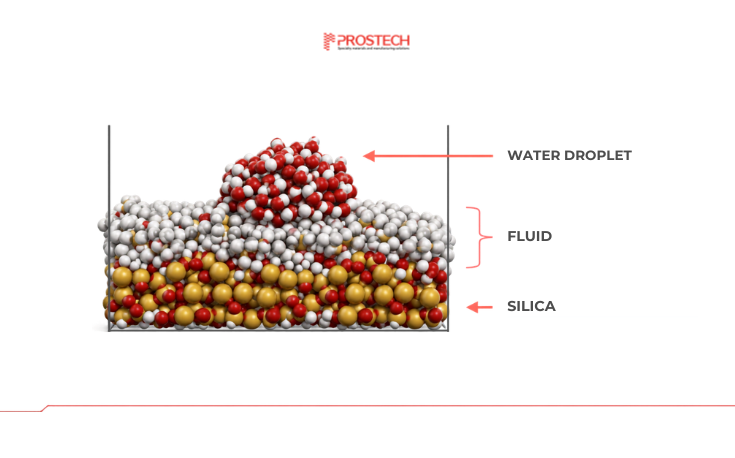
These two points should be read separately: the surface tension comparison above reflects an inherent property of each chemistry class, while the molecular tailoring described applies to the hydrophobicity of the coated surface itself. Available information does not indicate that architecture tailoring changes silicone’s underlying surface tension relative to PFAS.
Preliminary Performance Data of Hydrophobic Coatings for Glass
Below is data from internal testing, conducted on Gorilla Glass Generation 3 substrates, evaluated two coating concepts across coefficient of friction (CoF), initial water contact angle (WCA), and WCA retention after mechanical, thermal, and weathering stress.
| Product | Coating Method | CoF | Initial WCA | WCA after 4,000 Cloth Wiping Cycles | WCA after 3,000 Steel Wool Cycles | WCA after Xenon Weathering (250h/90°C) | WCA after Damp Heat (250h/85°C/85% RH) |
|---|---|---|---|---|---|---|---|
| Concept 1 | PVD, Spray, Flow, Wipe | 0.02–0.04 | 105–108° | ~105° | n/a | ~100–105° | ~105° |
| Concept 2 | PVD, Spray, Flow, Wipe | 0.06–0.09 | 99–102° | n/a | ~100° | ~95° | ~100° |
Three observations are directly supported by this data:
- PVD (dry) coating performs comparably to spray application (wet), giving manufacturers flexibility to select the deposition method that fits their existing line rather than re-engineering it. Flow and wipe application are also reported as viable.
- Optical performance is preserved. Haze and transmission remain within the reported acceptable range, which is a requirement for any coating applied to a display surface.
- Water contact angle values after 4,000 cloth-wiping cycles, 3,000 steel-wool cycles, xenon weathering, and damp heat testing remain close to initial values, indicating that hydrophobic performance is not limited to the as-coated state under the tested conditions.
This dataset is explicitly described as preliminary and is not intended to be used as, or to develop, a formal specification. It is presented here as an indication of technical direction. Engineers requiring specification-grade data for design qualification should contact Prostech’s technical team directly.
From Lab to Production Line: The Coating Process
The robotic spray coating process for this platform follows six controlled stages:
- Substrate cleaning — IPA solvent wipe combined with ionized air.
- Plasma treatment — Applied two to three times to bring the glass surface water contact angle below 10°, ensuring the surface is sufficiently activated before the hydrophobic layer is applied. Cerium oxide or acid/alkali pretreatment can serve as alternatives.
- Coating application — Applied at 23–25°C and 35–60% relative humidity, with a solids content of approximately 0.5–10%.
- Flash-off — A 5-minute dwell at 23–25°C and 35–60% RH, allowing solvent to evaporate before cure.
- Cure — Three validated pathways depending on line configuration: 100–150°C for 30–60 minutes, 60°C for 240 minutes, or 25°C for 24 hours at 35–60% RH.
- Final surface preparation — Parts are cooled, then wiped sequentially with a dry microfiber cloth, ethanol or IPA, and water.
This level of process definition gives process engineers a validated starting point rather than a blank slate. The availability of multiple cure pathways — including a room-temperature option — allows manufacturers to weigh cure speed against equipment investment based on their own production constraints.
Recommended Applications of Hydrophobic Coatings
Electronic device displays are one of the application areas listed for this coating platform, alongside cameras and optical devices, automotive glass, architectural glass, eyewear, and appliances. For displays specifically, the properties described above are directly relevant: low CoF and easy-to-clean performance address fingerprint and oil residue from touch contact; sustained water contact angle after repeated wiping cycles addresses the effect of routine cleaning; and preserved optical performance addresses the requirement that a coating not visibly affect display clarity.

It should be noted that the performance data presented was generated on Gorilla Glass Generation 3 as the test substrate. Gorilla Glass is commonly used in electronic display cover glass, but the data itself was not described as display-specific testing.
Other listed applications — cameras and optical devices, automotive glass, architectural glass, eyewear, and appliances — share the same underlying hydrophobic and anti-fingerprint requirements.
Prostech provides product access and technical consultation for this coating platform to manufacturers and OEMs. Given that current performance data remains at the preliminary stage, Prostech recommends engaging directly with our technical team to review substrate compatibility, discuss coating method selection, and determine testing requirements specific to your application.
Contact Prostech’s technical team to request further documentation or arrange a technical discussion on the advanced PFAS-Free, Hydrophobic Coatings for Glass.