

- Two Problems, One Root Cause: Worker Irritation and Coating-Grade Toxicity Failures
- Why Most Cyanoacrylate Adhesive Fail ISO 10993-5 Compliant in Coating Form
- The Compliance Gap: Bonded vs. Coating Across ECA, MECA, and bioCA
- What Changed: Low Blooming, Low Odor, and Certified HQ Levels Cyanoacrylate Adhesive
- Where the Coating-Grade Gap Opens New Applications for ISO 10993-5 Compliant Cyanoacrylate Adhesive
- Frequently Asked Questions
When engineers search for an ISO 10993-5 compliant cyanoacrylate adhesive, most assume that “ISO 10993-5 compliant” is a single checkbox — either a cyanoacrylate is biocompatible, or it isn’t. Published test data tells a more specific story: the same adhesive chemistry can pass ISO 10993-5 when used as a bonded joint, and fail the same standard when the identical material is applied as a surface coating. That distinction has quietly excluded standard cyanoacrylates from a range of medical device and precision electronics applications where coating-grade compliance is required.
This article walks through why that gap exists, what the comparative data shows across ECA, MECA, and a newer bio-based cyanoacrylate (bioCA), and where closing that gap opens up applications that were previously off-limits.
Two Problems, One Root Cause: Worker Irritation and Coating-Grade Toxicity Failures
Engineers sourcing cyanoacrylate adhesives for medical devices or precision electronics typically run into two seemingly unrelated issues that, in practice, share the same underlying cause — the chemistry and volatility of the adhesive itself:
- Production-line worker irritation. Standard ECA is documented to cause serious, frequent irritation, with workers developing specific allergies after repeated exposure. Even lower-blooming MECA can be irritating in industrial drum-sized containers, requiring protective masks.
- Coating-grade toxicity failures. When the same ECA or MECA chemistry is applied as a thin surface coating rather than a bonded joint, it fails ISO 10993-5 cytotoxicity testing — closing off applications like conformal coatings on implantable or skin-contact medical devices.
Why Most Cyanoacrylate Adhesive Fail ISO 10993-5 Compliant in Coating Form
ISO 10993-5 evaluates in-vitro cytotoxicity — whether a material, in the amount and surface area it is used, harms living cells on contact. A bonded joint exposes a small, fully cross-linked cross-section of cured adhesive at the seam line. A coating exposes a much larger surface area of the same material directly to tissue or fluid contact, which changes the exposure profile the test is measuring.
Published comparative data confirms this pattern holds across the two most common cyanoacrylate chemistries on the market today:
The Compliance Gap: Bonded vs. Coating Across ECA, MECA, and bioCA
| Property | ECA | MECA | Born2Bond Ultra K85 (bioCA) |
|---|---|---|---|
| ISO 10993-5 — bonded joint | OK | OK | OK |
| ISO 10993-5 — coating | Not OK | Not OK | OK |
| CLP labelling | Irritant | Non-irritant | Non-irritant |
| Odor | Strong irritant | Low | Low, hint of citrus |
| Blooming | High | Low | Very low |
| Hydroquinone (HQ) content | — | — | Certified below 10 ppm |
| Stickiness on skin contact | Rapid and unpleasant | Quite quick and unpleasant | Very little sensation (per consumer testing) |
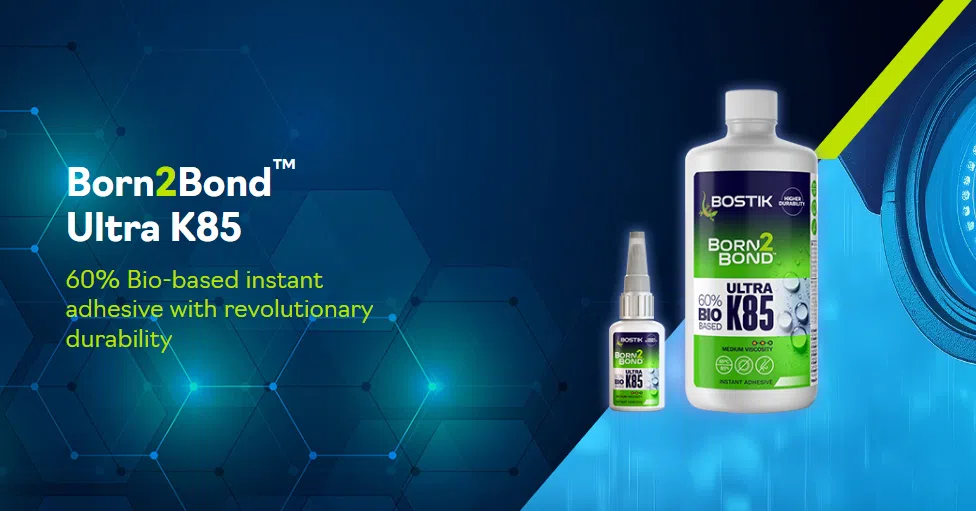
The bonded row is identical across all three chemistries — every cyanoacrylate type here passes as a bonded joint. The coating row is where the gap opens: ECA and MECA are both marked “Not OK” for coating-grade ISO 10993-5 use, while Born2Bond Ultra K85 is documented as compliant in both bonded and coating form.
What Changed: Low Blooming, Low Odor, and Certified HQ Levels Cyanoacrylate Adhesive
According to Bostik’s technical data, three specific properties of Ultra K85 drive this compliance difference:
Reduced volatility and blooming
The larger molecule size of the bioCA — made industrially viable through Bostik’s patented “crackless” manufacturing process — makes the adhesive far less volatile than standard ECA or MECA. This results in very low blooming (the white vapor-deposit residue that forms on component surfaces during curing) and reduces the toxicity load associated with coating-form applications.
Watch the blooming test between Born2Bond Ultra K85 (bioCA), ECA product and MECA product below.
Low, non-irritant odor
Where ECA is documented as a strong irritant and MECA can still irritate workers in industrial-volume settings, Ultra K85 is described as low-odor with a faint citrus note and carries a non-irritant CLP classification — the same classification as MECA, but with an improved coating-grade toxicity profile that MECA does not achieve.
Certified low hydroquinone (HQ) content
Hydroquinone occurs naturally within cyanoacrylate chemistry and is classified as carcinogenic. Bostik has certified HQ content in Ultra K85 below 10 ppm, directly supporting its overall lower-toxicity profile as a coating-grade material.
Where the Coating-Grade Gap Opens New Applications for ISO 10993-5 Compliant Cyanoacrylate Adhesive
Based on the documented compliance profile, the applications most directly affected by closing the bonded-vs-coating gap include:
- Medical devices requiring surface-contact compliance — where a conformal or protective coating layer, not just a bonded seam, needs to meet ISO 10993-5.
- Precision consumer electronics — earphone charging cases, LiDAR bonding, and wireless Bluetooth connections — where reduced blooming prevents vapor deposits from interfering with sensitive components, and remained bond-stable after 1,000 hours of temperature cycling on steel in testing.
- Luxury goods and leather repair — perfume bottles, bags, belts, and jewelry — where blooming is visually unacceptable and low-odor, low-stiffness bonding is preferred for finishing work.

Compliance Checklist for Medical Device and Precision Electronics Engineers
Before specifying a cyanoacrylate for an application involving surface coating or worker-intensive manual application, it’s worth confirming:
- Does your application require coating-grade ISO 10993-5 compliance, or only bonded-joint compliance? The two are not interchangeable, and most cyanoacrylate technical data sheets only report one.
- What is the CLP irritant classification of your current adhesive, and has production-line worker feedback (skin/eye irritation, allergy development) been documented over time?
- Is blooming/vapor deposit a functional risk for your component (e.g., optical surfaces, electrical contacts) or a cosmetic risk (visible white residue on finished goods)?
- Has hydroquinone content been certified by the supplier, or only assumed to be within typical range?
Contact our technical team to receive advice on your applications.
Frequently Asked Questions
What is the difference between ISO 10993-5 compliance for a bonded joint versus a coating?
ISO 10993-5 evaluates the in-vitro cytotoxicity of a material in contact with biological tissue. A bonded joint exposes a relatively small, fully cured cross-section of adhesive at the seam. A coating exposes a much larger surface area of adhesive directly to tissue or fluid contact. Published data shows that standard ECA and MECA cyanoacrylates pass ISO 10993-5 testing when bonded, but fail it when used as a coating, because the larger exposed surface changes the toxicity outcome.
Why do production workers report irritation from cyanoacrylate adhesives?
Standard ECA cyanoacrylates are classified as irritants under CLP labelling and are documented to cause frequent skin and eye irritation, with some workers developing specific allergies after repeated exposure, particularly with industrial drum-sized containers. This is linked to the adhesive’s vapor and blooming behavior during curing.
What is blooming in cyanoacrylate adhesives and why does it matter for electronics?
Blooming is a phenomenon where cyanoacrylate vapor condenses on the surface of a product or component, leaving a white deposit. It is documented to interfere with and cause failures in consumer electronic and audio products, and is considered unsightly on luxury goods, perfume bottles, and jewelry.
Is Born2Bond Ultra K85 certified for low hydroquinone content?
Yes. According to Bostik’s published data, the carcinogenic compound hydroquinone (HQ), which occurs naturally within cyanoacrylate chemistry, has been certified below 10 ppm in Born2Bond Ultra K85.