

Metal and plastic composites are increasingly bonded together in the same EV assembly to cut weight, but the two materials rarely move the same way when temperature or humidity shifts. That mismatch is the quiet cause behind a familiar field complaint: a joint that passes initial pull testing and then cracks months later. Solving it usually comes down to one overlooked adhesive property — how far the bondline can stretch before it lets go, which is where a metal-to-plastic bonding adhesive built for flexibility, not just raw strength, becomes the relevant fix.
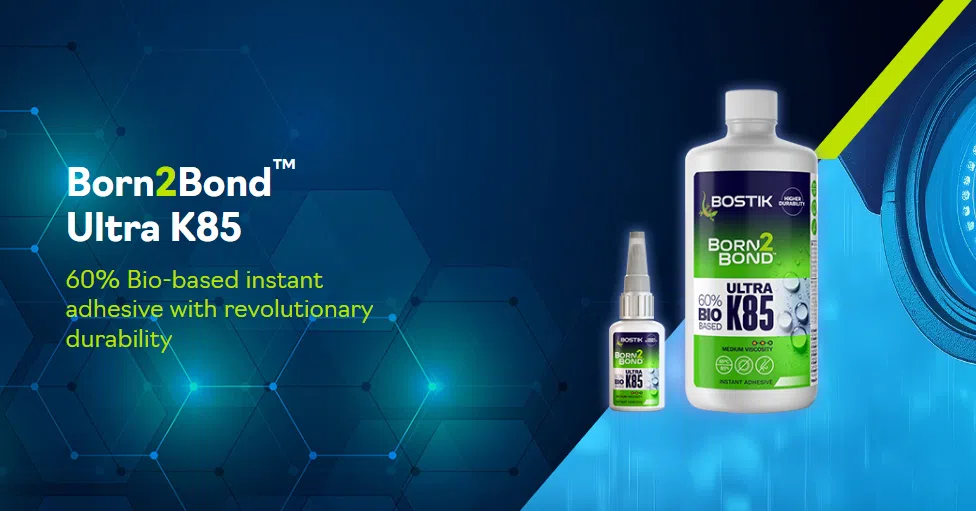
This technical overview is drawing on published data of a bio-based, long-chain cyanoacrylate, metal-to-plastic bonding adhesive engineered specifically to address this failure mode: Bostik Born2Bond Ultra K85
The Lightweighting Dilemma: Why Metal-to-Plastic Joints Fail Over Time
Every material has a coefficient of thermal expansion (CTE) — the rate at which it expands when heated and contracts when cooled. Metals and plastic composites do not share the same CTE. When a metal bracket is bonded to a plastic composite housing, the two parts expand and contract at different rates every time temperature or humidity shifts, whether from battery charging cycles, engine bay heat soak, or seasonal outdoor exposure.
A rigid adhesive bondline has nowhere to release that differential movement. Stress concentrates at the interface, and over enough cycles, the joint peels, cracks, or delaminates, even when the original tensile test result looked perfectly acceptable.
What Happens Mechanically When a Rigid Adhesive Meets a Flexing Joint
Picture two rulers made of different materials, glued edge to edge, then gently heated. If the glue line is rigid, it cannot accommodate one ruler moving more than the other, so the stress has to go somewhere — into micro-cracks at the bond interface. If the glue line is flexible enough to stretch and recover, it absorbs that differential movement instead of transferring it into a crack.
This is the mechanism engineers need to evaluate before specifying an adhesive for dissimilar-material joints: not just how strong it is, but how much it can stretch before it lets go.
Elongation at Break: The Number to Check Before Anything Else
Elongation at break measures how far a cured adhesive can stretch before it fractures. It is a direct proxy for how well a bondline will tolerate the differential expansion described above. According to Bostik’s published technical data, conventional cyanoacrylates offer very limited stretch:
| Adhesive Type | Elongation at Break | Bond Character |
|---|---|---|
| Standard ECA | 2% | Brittle |
| MECA | 8% | Less brittle |
| Born2Bond Ultra K85 (bioCA) | 30% | Flexible |
A 30% elongation figure means the cured bondline can flex roughly 15 times further than a standard ECA before it fails. In practical terms, this is what allows a metal-plastic composite joint, such as those in EV housings subject to daily heat cycling, to keep flexing with its substrates instead of cracking after the first few dozen cycles.
Watch the flexibility test of the three adhesives below.
Proof Under Stress: 85:85 and Immersion Test Data
Elongation numbers only matter if they hold up under accelerated aging. Bostik validated Ultra K85 using two industry-recognized stress tests: the 85:85 durability test (85% relative humidity at 85°C, a standard accelerated-aging protocol for evaluating long-term bond durability under combined heat and moisture) and a hot-water immersion test simulating repeated wash-cycle exposure.
| Test Condition | ECA | MECA | Born2Bond™ Ultra K85 |
|---|---|---|---|
| 85:85 test on mild steel (hours to bond degradation) | Max. 170 hours | Under 100 hours | Over 1,000 hours (42 days) |
| 85:85 test on ABS substrate | — | — | Up to 5,000 hours (208 days) |
| Immersion in soapy water at 70°C | 3 days | 1 day | Over 10 days |
| Max. service temperature | 120–140°C | 80°C | Up to 106°C in cycling tests (100°C rated) |
On steel, Ultra K85 remained durable roughly six times longer than standard ECA and more than ten times longer than MECA under the 85:85 protocol. On ABS composite substrate specifically, the type of plastic relevant to housings and brackets, durability extended to 5,000 hours in the same accelerated-aging regime.
Watch the 85:85 test of the three adhesives below.
Combined with the 30% elongation figure, this data points to a bond line that is both flexible enough to absorb CTE-driven movement and durable enough to survive the humidity and heat cycling that dissimilar-material EV joints are routinely exposed to.
Where This Matters Most: EV Assembly, MRO, and Composite Appliance Housings
Based on the documented performance profile, the most relevant applications include:
- EV structural and housing joints combining metal brackets with plastic composite panels (metal-to-plastic bonding), where thermal cycling from battery operation and ambient exposure is continuous.
- General assembly and MRO (maintenance, repair, and overhaul) of vehicles, where bonded joints are exposed to rain, heat, and cold over the vehicle’s service life.
- Home appliance composite components, such as washing machine parts, where repeated heat and moisture cycling mirror the same failure mode seen in automotive joints.
Key Takeaways of K85 Metal-to-Plastic Bonding Adhesive

- Metal-to-plastic joint failure in EV lightweighting is usually driven by CTE mismatch, not insufficient adhesive strength — a rigid bond line cannot absorb differential thermal expansion between dissimilar substrates.
- Elongation at break, not tensile strength alone, determines whether a bondline flexes with the joint or cracks under cycling.
- Born2Bond Ultra K85 elongates up to 30%, compared with 2% for standard ECA and 8% for MECA.
- In the 85:85 accelerated-aging test, Ultra K85 remained durable for over 1,000 hours on steel and up to 5,000 hours on ABS, versus a maximum of 170 hours (ECA) and under 100 hours (MECA).
- It is a 60% bio-based long-chain cyanoacrylate (bioCA), made from castor bean-derived heptanol using Bostik’s patented crackless manufacturing process.
Contact Prostech Technical Team for free sample test and further discussion on your applications!
Frequently Asked Questions
What is CTE mismatch and why does it cause adhesive bond failure?
CTE mismatch occurs when two bonded materials, such as metal and a plastic composite, expand and contract at different rates as temperature and humidity change. A rigid, low-elongation adhesive cannot absorb this differential movement, so stress concentrates at the bondline until the joint cracks or peels.
Why does elongation at break matter more than tensile strength for dissimilar-material bonding?
Tensile strength measures how much force a bond resists before failing under a single static pull. Elongation at break measures how much the cured adhesive can stretch before it fails. In dissimilar-material joints subject to repeated thermal or humidity cycling, elongation is often the more decisive property because it determines whether the bondline can flex with the substrates instead of cracking.
Is Born2Bond Ultra K85 a bio-based adhesive?
Yes. Born2Bond Ultra K85 is a long-chain alkyl cyanoacrylate (bioCA) that is 60% bio-based, using heptanol derived from castor beans. The heptanol is a co-product of Arkema’s Rilsan Polyamide 11 production, giving the supply chain a closed-loop, circular-economy profile.
How is Born2Bond Ultra K85 different from standard ECA or MECA cyanoacrylates?
Standard ethyl cyanoacrylates (ECA) elongate around 2% before breaking and methoxyethyl cyanoacrylates (MECA) around 8%. Born2Bond Ultra K85 Metal-to-Plastic Bonding Adhesive elongates up to 30%, and in the industry-standard 85:85 durability test its bond strength on mild steel lasted over 1,000 hours, compared with a maximum of 170 hours for ECA and under 100 hours for MECA.
Source: Data and figures in this article are drawn from Bostik’s white paper “Born2Bond™ Ultra K85: Creating More Sustainable Bonds” by Patxi Garra, Head of Technology Development, Afinitica (a Bostik company), ©2025 Bostik. Test results represent typical performance under Bostik’s stated test conditions and are not warranted for every application; substrate compatibility and process suitability should always be validated for your specific use case. Full technical data sheets (TDS) and safety data sheets (SDS) are available on request from Prostech, an authorized distributor of Bostik engineering adhesives.