

- 1. What is Polycarbonate Plastic?
- 2. Why Polycarbonate Bonding Requires a Specialized Approach
- 3. Polycarbonate Material Properties at a Glance
- 4. Adhesive Chemistry Comparison &
- Selection Matrix
- 5. Surface Preparation for Polycarbonate Bonding
- 6. Application-Specific Guidance
- 7. Selecting the Right Polycarbonate Adhesive: Decision Framework
- Prostech Polycarbonate Adhesive Solutions
- Frequently Asked Questions
1. What is Polycarbonate Plastic?
Polycarbonate (PC) is one of the most bonded engineering thermoplastics in industrial assembly — used in electronics enclosures, automotive lighting, medical device housings, and optical components. Yet selecting the wrong polycarbonate adhesive causes a failure mode that is difficult to detect until it is too late: stress cracking (crazing), a network of microscopic fractures that compromises both structural integrity and optical clarity.
This guide covers the adhesive chemistries, selection criteria, and surface preparation protocols that engineers and OEM manufacturers need to make confident bonding decisions for polycarbonate substrates.
Read more: Plastics Bonding – What is the most effective adhesive?
2. Why Polycarbonate Bonding Requires a Specialized Approach
Before selecting a polycarbonate adhesive, engineers must account for three material properties that directly affect bond performance:
2.1. Susceptibility to Chemical Stress Cracking (Crazing)
Polycarbonate is an amorphous thermoplastic. Unlike semi-crystalline polymers such as nylon or PEEK, PC has no crystalline regions to absorb chemical stress. When the surface comes into contact with incompatible solvents or reactive monomers — including those present in standard cyanoacrylate or solvent-cement formulations — the polymer chains absorb the chemical and begin to separate, forming the characteristic crazing pattern.
Crazing risk is amplified when the part is under mechanical stress (hoop stress, assembly press-fit, residual molding stress). Engineers must specify adhesives formulated with monomers selected to provide adhesion without penetrating the PC polymer matrix.
2.2. High Coefficient of Thermal Expansion (CTE)
Polycarbonate has a linear CTE of 65–70 × 10⁻⁶/K (Wikipedia, Polycarbonate material data). This is approximately 3–4× higher than aluminum (23 × 10⁻⁶/K) and over 6× higher than steel (11–13 × 10⁻⁶/K).
For PC-to-metal assemblies operating across a wide temperature range, the differential thermal expansion generates shear stress at the bond line with every thermal cycle. Adhesive selection must account for sufficient flexibility or elongation-at-break to absorb this movement without bond-line failure.
2.3. UV-Stabilized vs. Non-UV-Stabilized Grades
Many industrial PC grades — especially those used in outdoor lighting, automotive glazing, and industrial enclosures — incorporate UV stabilizers that absorb UV wavelengths below approximately 400 nm. When using UV-cure adhesives on UV-stabilized PC, adhesives formulated to cure at 365 nm will exhibit incomplete or inconsistent cure. For UV-stabilized polycarbonate, specify UV adhesives with activation wavelengths in the 400–420 nm (visible light) range to ensure full cure depth and bond strength.
3. Polycarbonate Material Properties at a Glance
| Property | Value |
|---|---|
| Surface energy | ~42 mJ/m² |
| CTE (linear) | 65–70 × 10⁻⁶/K |
| Max. service temperature | 115–130°C |
| Softening (Vicat) temperature | ~147°C |
| Optical transmittance (3 mm) | >88% visible spectrum |
| Material structure | Amorphous |
A surface energy of 42 mJ/m² places polycarbonate in a favorable bonding range — well above low-surface-energy plastics like polypropylene (29–31 mJ/m²) and polyethylene (31–33 mJ/m²). According to Permabond, bond strength on PC substrates frequently exceeds the substrate strength itself when the correct adhesive chemistry is used.
4. Adhesive Chemistry Comparison &
Selection Matrix
4.1. Cyanoacrylate (CA) Adhesives
Best for: High-speed production lines, small bond areas, PC-to-PC and PC-to-metal quick-fix assembly.
Cyanoacrylate adhesives develop fixture strength in seconds, making them the default choice for high-throughput assembly. They perform well on polycarbonate’s moderate surface energy without requiring a primer.
Key technical considerations:
- Use the minimum quantity necessary to minimize excess adhesive on the PC surface. Uncured CA in liquid form can cause stress cracking on exposed PC surfaces if allowed to pool outside the bond line.
- For applications where optical appearance matters, specify a low-odor, low-bloom grade (e.g., Permabond 940) to minimize the white residue (bloom) that can form near the bond area.

- Gap-fill is limited to approximately 0.5 mm; not suitable for poorly fitted or flexible joints.
- CA bonds can become brittle under prolonged vibration or impact loading — not recommended for dynamic structural applications.
When to avoid: Assemblies under significant hoop stress (cylindrical press-fit joints), applications requiring impact resistance or wide temperature cycling, outdoor service.
4.2. UV-Cure Adhesives
Best for: Transparent PC assemblies, optical applications, electronics display housings, medical device assembly where bond line visibility is critical.
UV adhesives cure on-demand upon UV/visible light exposure, providing excellent optical clarity and a bond line that is virtually invisible. This makes them the preferred choice for PC used in optical instruments, display covers, LED lighting covers, and transparent enclosures.
Key technical considerations:
- For non-UV-stabilized polycarbonate: standard UV adhesives curing at 365 nm are compatible.
- For UV-stabilized polycarbonate: specify visible-light-cure products activating at 400–420 nm, such as Permabond UV630 or UV640, to achieve complete cure through the UV-stabilizer layer.

- Cure depth is limited by light penetration — opaque substrates or shadow zones require a secondary moisture- or heat-cure mechanism.
- Bond strength from Dymax Ultra Light-Weld series on polycarbonate: high-strength, suitable for sealing and encapsulation in electronics assembly.
- Momentive INVISISIL OP2131S (UV-cure silicone): used for optical bonding of PC display covers — provides non-yellowing, optically clear bonds with low shrinkage and stable modulus under thermal shock, primarily for touchscreen electronics and display assembly.
4.3. Structural Acrylic (MMA) Adhesives
Best for: Structural assemblies exposed to outdoor environments, vibration, or wide temperature ranges; PC-to-metal bonding; high-strength industrial applications.
Two-component methacrylate (MMA) adhesives are the top-tier choice for demanding structural polycarbonate bonds. They deliver high lap shear strength, impact resistance, and fatigue endurance while being specifically formulated to avoid crazing.
Key technical considerations:
- ITW Plexus MA3940 is the industry standard for bonding substrates sensitive to crazing such as polycarbonate and acrylic. It provides a combination of fatigue endurance, outstanding impact resistance, and superior toughness.
- ITW Plexus MA300 achieves lap shear strength of 20.7–26.2 MPa (3,000–3,800 psi) on thermoplastics including polycarbonate (ASTM D1002).
- MMA adhesives are highly tolerant of off-ratio mixing and broader surface preparation conditions compared to standard 2-part epoxies or polyurethanes.
- Dispensed via static mix nozzle from dual cartridges; compatible with automated dispensing systems.
- Not suitable for optical-clarity applications — MMA systems are typically opaque (cream, black, or grey).
4.4. Epoxy Adhesives
Best for: Rigid structural bonds in non-optical applications; PC in high-temperature service when two-part epoxy is specified.
Important limitation:
- Single-component (1K) heat-cure epoxies are generally not recommended for polycarbonate bonding. The minimum cure temperature of most 1K epoxy systems (typically 120–180°C) exceeds the PC service temperature range of 115–130°C, risking substrate distortion or damage during cure. According to Permabond, 1K epoxies present this compatibility risk on most engineering plastics.
- Two-component (2K) epoxies cure at room temperature and are suitable for polycarbonate in rigid structural applications. Select flexible or toughened 2K epoxy grades for assemblies exposed to thermal cycling or vibration to avoid brittle joint failure.
Explore our epoxy adhesive solutions here or contact us now for expert consultation and personalized recommendations!
4.5. Silicone Adhesives
Best for: PC-to-metal or PC-to-glass sealing, flexible assemblies, outdoor weathering, applications requiring service from –50°C to +200°C.
Silicone adhesives provide the widest service temperature range and the highest elongation-at-break of all adhesive types, making them suitable for sealing polycarbonate assemblies where flexibility is required. They are not structural by nature — lap shear strength is lower than CA, MMA, or epoxy systems — but they accommodate large CTE mismatches in PC-to-metal assemblies effectively.
Explore Prostech’s silicone adhesive solutions:
4.6. Adhesive Selection Matrix
| Adhesive Type | Bond Strength | Crazing Risk | Optical Clarity | Gap Fill | PC-to-Metal | Best Industry Application |
|---|---|---|---|---|---|---|
| Cyanoacrylate (CA) | Medium-High | Low (use correctly) | Clear | ≤0.5 mm | Suitable | Electronics, general assembly |
| UV Adhesive | High | Low | Excellent | Medium | Suitable | Optical, display, medical |
| Structural Acrylic (MMA) | Very High | Very Low | Opaque | Up to 3+ mm | Excellent | Automotive, outdoor, structural |
| 2K Epoxy | High | Low | Opaque/clear grades | Wide | Excellent | Industrial structural |
| Silicone (RTV) | Low-Medium | Very Low | Clear grades available | Wide | Excellent (flexible seal) | Sealing, outdoor, thermal cycling |
5. Surface Preparation for Polycarbonate Bonding
Correct surface preparation is critical for achieving maximum bond strength and avoiding cohesive failure at the adhesive–PC interface.
Safe solvents for PC surface cleaning:
- Isopropyl alcohol (IPA) — recommended; effective for removing surface oils, mold release agents, and fingerprints without attacking PC.
- Methyl ethyl ketone (MEK), acetone, toluene, methylene chloride — avoid. These are aggressive solvents that will initiate crazing on PC surfaces, particularly under residual assembly stress.
Protocol for production environments:
- Wipe surface with lint-free cloth dampened with IPA.
- Allow to air dry for 2–3 minutes before adhesive application.
- Apply adhesive immediately — do not allow dust re-contamination of cleaned surfaces.
- For CA adhesives: use the minimum adhesive volume to avoid excess pooling on the PC surface outside the joint.
Mold release agent removal: PC injection-molded parts often carry residual mold release agents that significantly reduce bond strength. Ensure full cleaning of injection-molded PC parts before bonding, particularly around parting lines.
6. Application-Specific Guidance
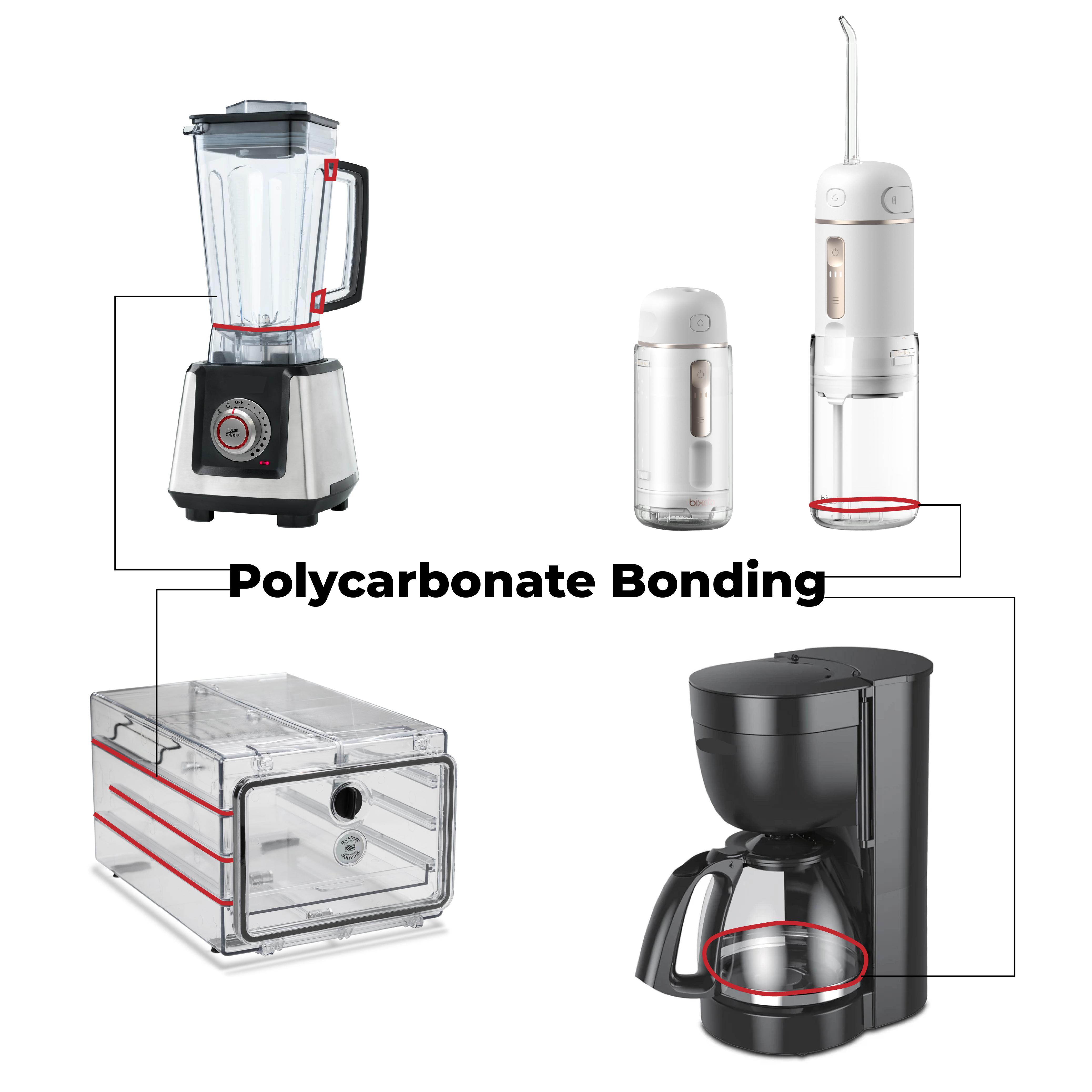
6.1. Electronics Enclosures and Housings
PC is widely used for electronics enclosures due to its impact resistance, dimensional stability, and UL 94 flammability ratings (PC inherently achieves V-2 ratings; flame-retardant grades achieve V-0). Recommended adhesive: CA adhesive (low-bloom grade) for sub-assemblies requiring fast cycle time; UV adhesive for transparent cover bonding where optical clarity is required. For sealed enclosures, RTV silicone provides flexible sealing between PC and metal chassis components.
Prostech specializes in adhesive solutions for the Electronics and Home Appliance industries. Contact us for expert consultation on your adhesive needs.
6.2. Medical Device Assembly
Polycarbonate is used in medical devices including catheter components, surgical robot housings, and diagnostic device enclosures.
Key requirement: ISO 10993 biocompatibility compliance.
UV adhesives are preferred where assembly visualization under light is possible during production.
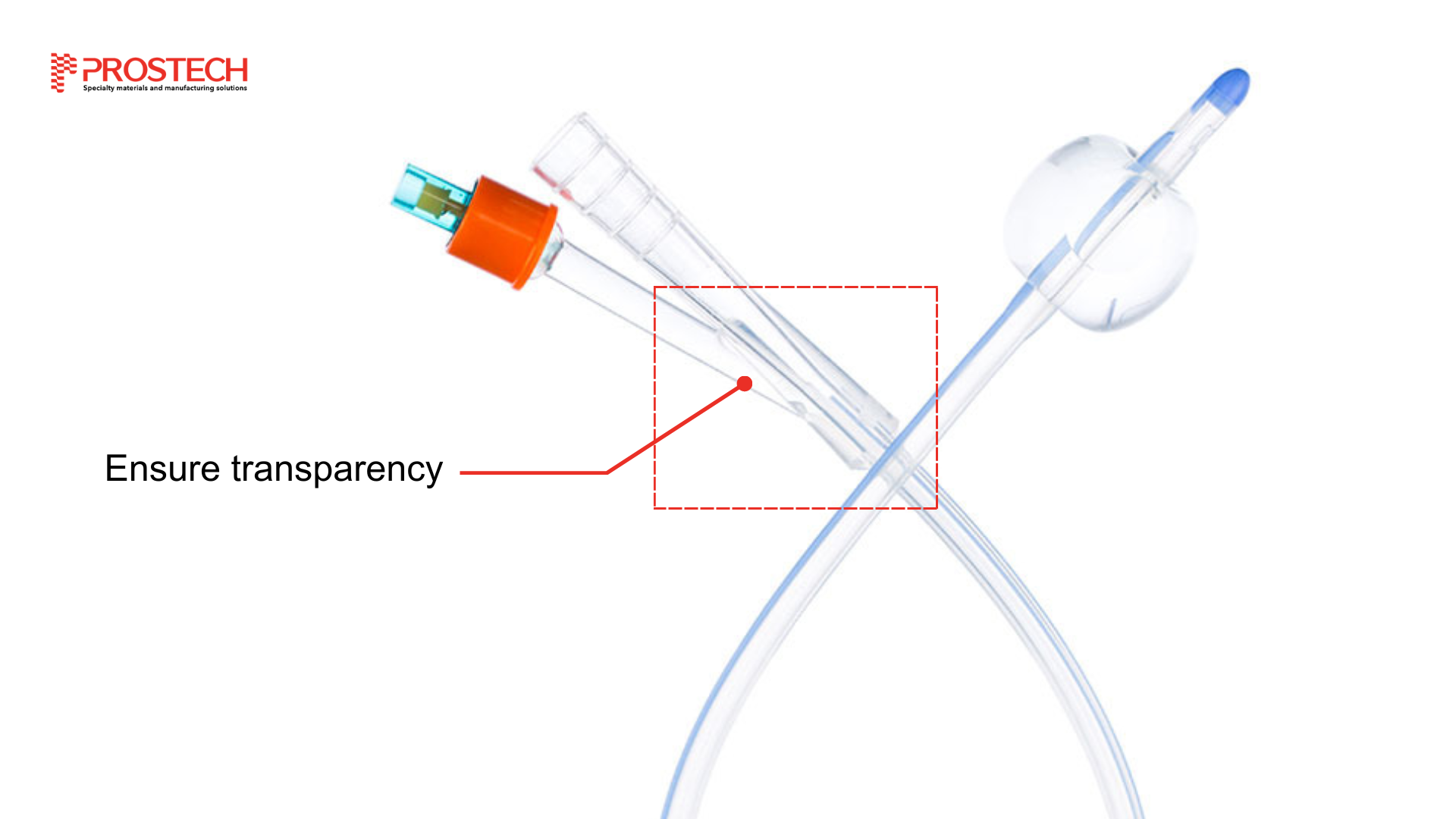
Contact Prostech technical team to discover product’s biocompatibility certification for your applications.
6.3. Automotive Lighting and Glazing
PC glazing and lighting lenses are UV-stabilized. UV adhesives must be visible-light-cure grade (400–420 nm activation); standard 365 nm UV adhesives will not cure reliably through UV-stabilized PC.
For lens-to-housing sealing with CTE cycling requirements (–40°C to +85°C typical automotive thermal profile), flexible MMA or silicone adhesives are the engineering-grade choice. Structural acrylic (MMA) adhesives from ITW Plexus are qualified under automotive and transportation specifications.
6.4. Optical and Display Applications
For transparent PC display covers, light guide panels, and optical instrument housings, bond line clarity is the primary requirement. Use UV-cure optical adhesives or silicone optical bonding materials.
Momentive INVISISIL series silicones are engineered for optical bonding of PC display screens, providing non-yellowing performance and stable optical properties under thermal shock — a critical requirement for outdoor and automotive display assemblies.
7. Selecting the Right Polycarbonate Adhesive: Decision Framework
Use the following decision tree to narrow adhesive type before product-level selection:
- Is optical clarity required?
- Yes → UV adhesive or optical silicone
- No → proceed to step 2
- Is the substrate UV-stabilized PC?
- Yes + UV adhesive → must specify 400–420 nm visible-light-cure grade
- No → standard UV adhesive is suitable
- Is structural load-bearing required?
- Yes, with vibration/impact/outdoor service → Structural Acrylic (MMA)
- Yes, rigid static bond → 2K Epoxy
- No → CA adhesive for fast production; silicone for sealing
- Does the assembly involve PC bonded to metal?
- Yes, with thermal cycling → Flexible MMA or silicone (see CTE mismatch guidance)
- Yes, static joint → 2K epoxy or MMA
- Is ISO 10993 biocompatibility required?
- Yes → Specify products with ISO 10993 certification; consult manufacturer TDS
Prostech Polycarbonate Adhesive Solutions
Prostech is an authorized distributor of industrial adhesive brands for polycarbonate bonding, including Permabond, ITW Performance Polymers (Plexus, Tru-Bond), Momentive, and Henkel (LOCTITE). Our technical team provides application-level consultation to match adhesive chemistry, dispensing method, and cure process to your specific polycarbonate assembly requirements.
For product selection, bond testing support, or volume pricing, contact our technical team.
For a broader overview of adhesive selection across all plastic substrate types, see our guide: Plastics Bonding – What Is the Most Effective Adhesive?
Frequently Asked Questions
Does super glue (cyanoacrylate) work on polycarbonate?
Yes — industrial-grade CA adhesives bond polycarbonate effectively. However, use the minimum quantity to prevent surface contact of uncured CA outside the joint, which can cause crazing. Choose a low-bloom, low-odor grade for optical or appearance-critical applications.
What causes polycarbonate to crack after bonding?
The most common cause is chemical stress cracking (crazing), triggered by incompatible solvents or aggressive adhesive monomers contacting the PC surface under mechanical stress. Ensure the adhesive chemistry is PC-compatible, clean with IPA only, and avoid excessive adhesive squeeze-out on the PC surface.
Can epoxy be used on polycarbonate?
Two-part (2K) epoxies are suitable. Single-part (1K) heat-cure epoxies should be avoided, as their cure temperatures (120–180°C) typically exceed the PC service temperature, risking substrate damage.
Which adhesive is best for UV-stabilized polycarbonate?
Use UV adhesives with visible-light activation at 400–420 nm (not standard 365 nm). Permabond UV630 and UV640 are specifically recommended for UV-stabilized PC. For structural bonding, ITW Plexus MMA adhesives perform without UV light dependency.
How do I bond polycarbonate to metal?
For structural PC-to-metal bonding across thermal cycling conditions, use a flexible or toughened structural acrylic (MMA) adhesive or a flexible 2K epoxy to accommodate the CTE differential (PC: 65–70 × 10⁻⁶/K; aluminum: ~23 × 10⁻⁶/K; steel: ~12 × 10⁻⁶/K). For sealing applications, flexible silicone adhesives are preferred. See our guide on bonding plastic to metal for detailed selection criteria.
What is the maximum service temperature for adhesives on polycarbonate?
PC itself has a maximum service temperature of 115–130°C. Two-part epoxies and structural acrylics typically handle up to 120°C; silicone adhesives provide the broadest range, from –50°C to +200°C, and are preferred for applications subject to thermal extremes.
Need help selecting the right adhesive? Contact Prostech for expert consultation and customized adhesive solutions tailored to your needs.