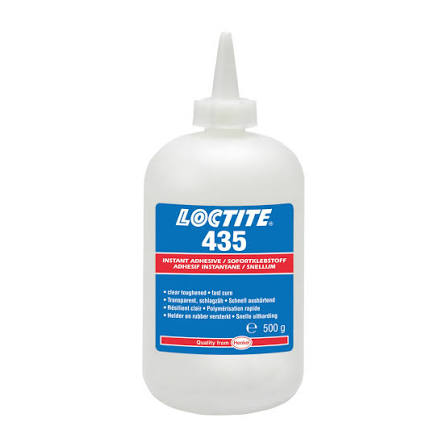
LOCTITE 435 is a rubber-toughened cyanoacrylate adhesive. It provides increased flexibility and peel strength. This formulation also offers enhanced resistance to shock. It delivers rapid bonding across a wide range of industrial materials.
General Information of LOCTITE 435
LOCTITE 435 utilizes advanced ethyl cyanoacrylate technology. This one-part system requires no mixing, simplifying application processes. It presents as a colorless to straw-colored, slightly cloudy liquid. This low-viscosity adhesive ensures precise dispensing and excellent substrate wetting. Humidity initiates its curing process. Full functional strength develops rapidly. However, complete chemical and solvent resistance requires approximately 24 hours of cure time.
Furthermore, LOCTITE 435 forms robust bonds on diverse substrates. These include metals, plastics, and elastomers. It also effectively joins porous and absorbent materials. Examples are wood, paper, leather, and fabric. This versatility makes it ideal for complex assemblies. The product has undergone testing to Henkel’s protocols. These align with ISO 10993 biocompatibility standards. Consequently, it suits applications within the medical device industry.
Key Features & Technical Benefits
- Rubber Toughened Formulation: This adhesive incorporates rubber particles. It significantly enhances flexibility and peel strength. This prevents brittle failures under stress.
- Superior Shock Resistance: LOCTITE 435 effectively absorbs impact and vibration. It maintains bond integrity in dynamic and high-stress environments. This extends product lifespan.
- Rapid Fixture Time: The adhesive achieves handling strength quickly. Fixture times range from under 5 seconds on nitrile rubber to 10-20 seconds on ABS. This accelerates assembly processes and boosts production efficiency.
- Versatile Substrate Adhesion: It bonds a broad spectrum of materials. These include steel, aluminum, PVC, polycarbonate, and various rubbers. This simplifies material selection for complex, multi-material designs.
Typical Industrial Applications
This formulation is engineered for the following applications:
- Precision bonding of electronic components, ensuring durability.
- Assembly of medical devices, meeting stringent biocompatibility requirements.
- High-performance bonding of plastics and elastomers in automotive and consumer product manufacturing.
About Prostech
Prostech offers specialty materials (adhesives, tapes, thermal interface materials, insulating materials, sealants, PCB protection materials, …) along with manufacturing solutions. We proudly serve a wide range of industries and are an authorized distributor for leading global manufacturers of industrial materials and equipment. Our product range is designed to deliver customized solutions that address each customer’s unique needs.
With years of experience and a successful project history, we are confident in our ability to provide comprehensive material solutions. These solutions effectively tackle the challenges manufacturers face. To explore our full product catalog, simply click here. Our dedicated team is ready to assist with:
- Provide quotation, sample, TDS/MSDS, and technical consultation
- Testing sample quality and verifying product compatibility in our laboratory
- Customizing material formulas for special applications
- Adapting product sizes, quantities, and packaging to meet specific needs
- Offering expert advice on suitable equipment and automation processes
- Delivering technical training and on-site support for optimal product use
Moreover, Prostech ensures the safe and accurate global delivery of all materials, including “dangerous goods”, in compliance with legal regulations. For personalized technical support or to receive a quotation, please contact us today.
| Property | Value |
| Technology | Cyanoacrylate |
| Chemical Type | Ethyl cyanoacrylate |
| Components | One part - requires no mixing |
| Appearance (uncured) | Colorless to straw colored, slightly cloudy liquid |
| Viscosity @ 25 °C | 100 to 250 mPa·s (cP) |
| Specific Gravity @ 25 °C | 1.1 |
| Glass Transition Temperature | 130 °C |
| Lap Shear Strength (Steel) | 19 N/mm² |
| 180° Peel Strength (Steel) | 4 N/mm |
| Dielectric Breakdown Strength | 25 kV/mm |