

- What Is Jetting? Why It Matters for Electronics Assembly? Why 3M Scotch-Weld 6100?
- Why 3M Scotch-Weld 6101 Off-White Is Well-Suited for Jetting
- Dispense Parameter Table — 3M Scotch-Weld 6101 Off-White
- Troubleshooting Jetting Defects
- Setup Checklist Before Your First Jetting Trial
- A Note on Cleaning
- Ready to Run a Jetting Trial?
What Is Jetting? Why It Matters for Electronics Assembly? Why 3M Scotch-Weld 6100?
When adhesive placement accuracy is measured in microns, jetting is the method of choice, and 3M Scotch-Weld 6100 is a highly recommended adhesive.
Unlike needle dispensing, jetting is a non-contact dispensing technique: the adhesive never touches the valve nozzle during application. Instead, individual droplets are ejected from the jet valve and land on the substrate — similar in principle to inkjet printing, but using structural adhesive.
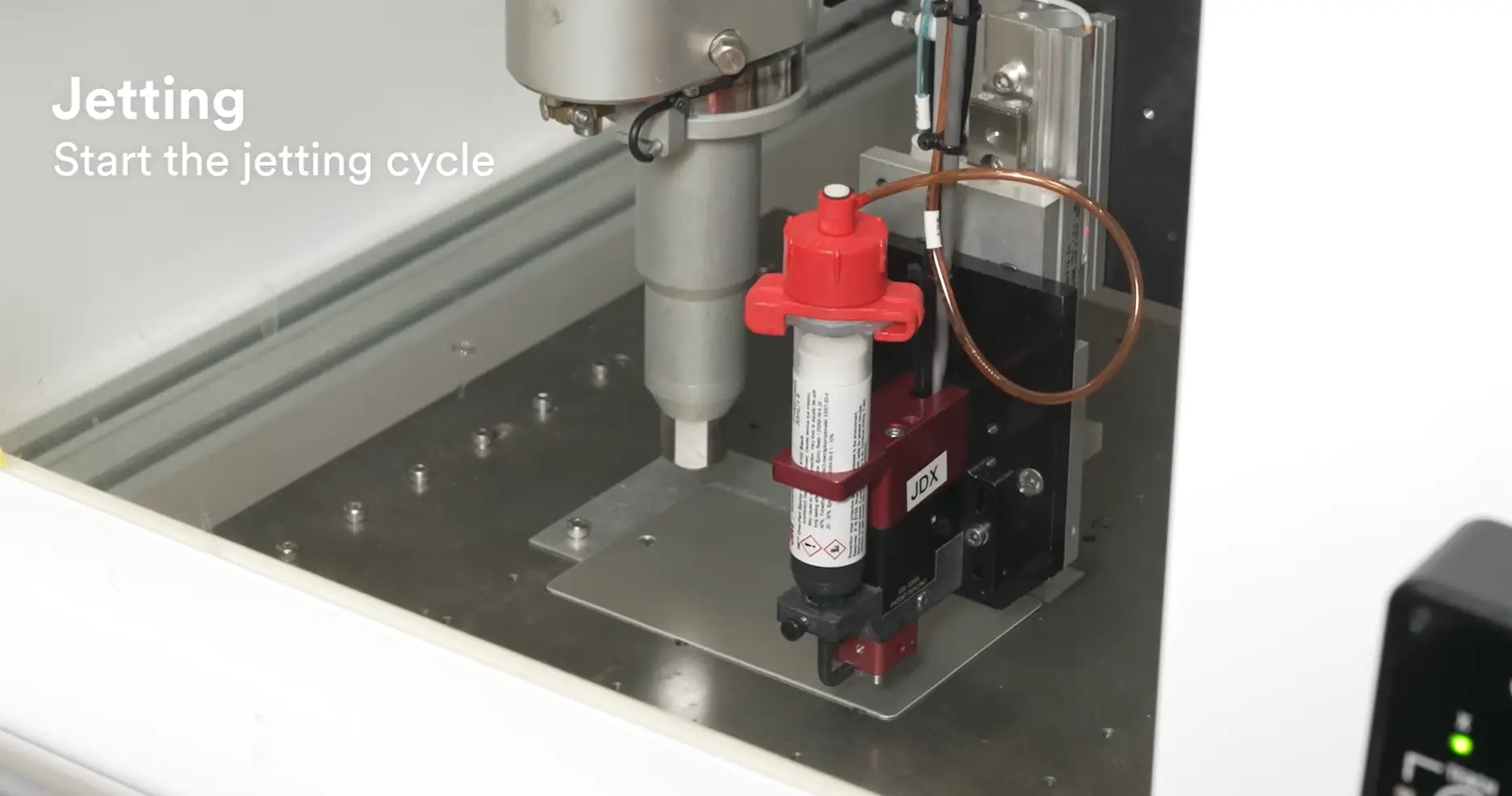
Jetting vs. Needle Dispensing — Quick Comparison
| Criteria | Jetting | Needle Dispensing |
|---|---|---|
| Substrate contact | Non-contact | Direct contact |
| Cycle speed | Up to 500 Hz | Significantly lower |
| Placement accuracy | Very high (±micron) | Dependent on Z-height |
| Minimum volume | Down to < 0.05 µL | Limited by needle diameter |
| Valve maintenance | Fewer wetted components | More frequent needle cleaning |
| Initial equipment cost | Higher | Lower |
Key characteristics of jetting technology:
- Drop-on-demand — each shot dispenses one discrete droplet, or multiple shots in rapid succession for larger volumes
- High cycle speed — jet valves can cycle up to 500 Hz, enabling fast dispensing of lines and patterns
- Minimal wetted components — valve design reduces parts in contact with adhesive, simplifying maintenance and cleaning
- Drive mechanism — jet valves are either pneumatically or piezoelectrically driven depending on the manufacturer
In electronics manufacturing — where bond areas can be as small as a single component pad — jetting provides the placement accuracy and repeatability that bead dispensing cannot match.
Why 3M Scotch-Weld 6101 Off-White Is Well-Suited for Jetting
3M Scotch-Weld 6101 Off-White is a one-part, heat-cure epoxy with thixotropic rheology — it flows under shear stress (during jetting) but holds its shape once deposited. This behavior is what makes it compatible with jet valve dispensing.
Key properties relevant to jetting:
- Long room-temperature pot life — 4 weeks at 25°C after opening; adhesive remains stable in the syringe during extended production runs
- Flexible and toughened after cure — 100% elongation at break, absorbing mechanical shock in assembled devices
- UV tracer — allows post-dispense inspection using UV light to verify placement accuracy before cure
- Low-temperature cure — 65°C / 20 min or 90°C / 3 min, avoiding thermal damage to plastic housings, batteries, or magnets
Dispense Parameter Table — 3M Scotch-Weld 6101 Off-White
The following parameters were generated using a PVA Delta 8 robotic cell with a JDX Jet Valve, EPDM diaphragm, and ceramic nozzle. Adhesive was jetted onto aluminum at room temperature and cured for 1 hour at 60°C.
Important notice: These values are directional starting points. Actual parameters will vary depending on your equipment, substrate, and environment. Always run validation trials before production.
Table 1 — Parameters by Dispensed Bead Volume
| Dispensed Bead Volume (µL) | 0.05 | 0.15 | 0.25 | 0.35 | 0.45 | 0.55 | 0.65 | 0.75 |
|---|---|---|---|---|---|---|---|---|
| Bead Height (mm) | 0.16 | 0.28 | 0.35 | 0.40 | 0.45 | 0.47 | 0.50 | 0.53 |
| Bead Diameter (mm) | 0.63 | 1.08 | 1.30 | 1.46 | 1.59 | 1.68 | 1.77 | 1.84 |
| Dispense Time (s) | 0.012 | 0.07 | 0.11 | 0.15 | 0.19 | 0.21 | 0.25 | 0.29 |
Table 2 — Fixed Parameters
| Parameter | Value |
|---|---|
| Refill Time | 10 ms |
| Dwell Time | 5 ms |
| Jet Pressure | 450 kPa |
| Fluid Pressure | 240 kPa |
| Valve Temperature | 40°C (do not exceed) |
| Orifice Diameter | 200 µm |
| Stand-off Height | 5 mm |
Troubleshooting Jetting Defects
This is where most engineers come first. Below are the most common jetting issues and how to address them.
Symptom: Adhesive accumulates around the nozzle opening instead of firing cleanly as a discrete droplet.
Root causes & fixes:
- Ensure the valve is clean — any cured material residue on the nozzle will disrupt droplet formation. Clean per the jet valve manufacturer’s recommendation.
- Increase jet pressure to improve droplet ejection force
- Increase valve temperature slightly (do not exceed 40°C) to reduce viscosity at the nozzle
- Increase dwell time to allow full pressure buildup before the next cycle
Symptom: Small secondary droplets appear around the main bead on the substrate, creating contamination or bond area inconsistency.
Root causes & fixes:
- Decrease jet pressure — excess pressure is the most common cause of satellites
- Decrease valve temperature — a lower temperature increases adhesive viscosity, helping the droplet break cleanly from the nozzle
Symptom: The parameter table does not cover the bead size required for your application.
Fix: Try switching to a smaller orifice nozzle plate. Note that all dispense parameters will shift and need to be fully re-validated.
Symptom: Individual drops do not merge into a continuous bead as required by the design.
Fix: Jetting can produce continuous lines by stitching individual drops together. To achieve this, increase robot movement speed so successive drops overlap and merge into a seamless bead. The appropriate speed depends on your drop volume and substrate.
Setup Checklist Before Your First Jetting Trial
Before running parameter optimization, confirm the following:
- Adhesive has been thawed at room temperature for 1–2 hours (do not heat above 27°C when warming)
- Jet valve has been cleaned and inspected — no cured material on nozzle or diaphragm
- Syringe pressure and fluid circuit checked for leaks
- Substrate is clean and at room temperature
- Cure oven is stabilized at target temperature before parts enter
A Note on Cleaning
Incorrect cleaning procedures can permanently damage a jet valve — and replacement costs are significant. Two principles to keep in mind:
Principle 1 — Always follow the valve manufacturer’s guidelines: Solvents and cleaning procedures vary significantly between pneumatic and piezoelectric valve designs. Do not use any unconfirmed solvent.
Principle 2 — Do not assume MEK or IPA is safe: Incompatible solvents can degrade seals and diaphragms. Always confirm with the valve manufacturer before using any solvent.
Ready to Run a Jetting Trial?
Dialing in jetting parameters on a new adhesive takes time — and the cost of a failed trial is real in a production environment.
Prostech’s Application Engineers can support your jetting qualification process directly: starting-parameter review, on-site dispensing trials at your facility or at our lab in Vietnam, and documentation for your material qualification package.
Technical data sourced from 3M Jetting Guide for Scotch-Weld One-Part Epoxy Adhesives 6101 Off-White (Technical Bulletin, February 2020). All parameters are directional — validate in your specific process environment.