

Mastering the full guide to prepare glass surfaces in Automotive Manufacturing is the only way to eliminate catastrophic bond failure. It is a critical, non-negotiable step for any modern OEM or Tier 1 supplier seeking zero-defect reliability.

Source: Internet
In modern Automotive Manufacturing, glass usage has evolved far beyond standard windows. Today, glass surfaces preparation is essential for structural windshields, panoramic sunroofs, LiDAR covers, and even Advanced Driver Assistance Systems (ADAS) camera lenses. These high-tech applications play a key role in guaranteeing passenger safety and sensor accuracy. When the structural adhesive fails because an engineer did not properly prepare glass surface areas, the consequences range from minor leaks to life-threatening structural collapses.

Source: Internet
While most bond failures are blamed on the adhesive, forensic analysis reveals the root cause is almost always inadequate glass surfaces preparation.
This article provides a deep-dive, step-by-step technical guide to prepare glass surface in Automotive Manufacturing components and eliminate failure on your assembly line.
-
Manufacturing Challenges when Preparing Glass Surfaces
To the naked eye, a freshly unboxed glass component appears pristine. At the microscopic level, however, it presents several chemical and physical barriers that complicate glass surfaces preparation in Automotive Manufacturing:
- Invisible Contaminants: Glass arrives at the assembly line carrying microscopic residues like cutting fluids, mold release agents, machine oils, and airborne factory hydrocarbons.
- Low Surface Energy (Wettability): Modern glass is often engineered with AR coatings or ceramic frits. These lower the surface energy, causing adhesives to “bead up” rather than flow. Effective glass surfaces preparation must reverse this.

Source: Internet
- Hydrophilicity (Moisture Attraction): Glass surfaces are covered in hydroxyl groups (-OH), attracting a microscopic layer of water. To correctly prepare glass surface units, you must displace this water layer, or the bond will fail through hydrolysis.
Failing to address these challenges during glass surfaces preparation in Automotive Manufacturing leads to expensive warranty claims and safety recalls.
These common challenges require engineers to carefully follow guide to prepare glass surfaces in Automotive Manufacturing to achieve utmost adhesion and optimal performance.
Feel free to contact our experts to receive technical advice for your own challenges.
2. The Full Guide for Glass Surfaces Preparation in Automotive Manufacturing
To ensure structural integrity, a standardized guide to prepare glass surfaces in Automotive Manufacturing, including three-essential-stage should be followed.
Stage 1: Cleaning and Degreasing Glass Surfaces
The foundational step in glass surfaces preparation in Automotive Manufacturing is the complete removal of gross organic contaminants.
- The Process: Wipe the glass with a high-purity industrial solvent like Isopropyl Alcohol (IPA) or a 50/50 mix of IPA and deionized water is the industry standard for safe, rapid evaporation. Here is a list of high-standard IPA for your reference.

Source: Prostech
The Rule: Always use lint-free wipes and wipe in a single direction to pull contaminants away rather than smearing them.
Product Recommendations: Isopropyl alcohol ES5505; Isopropyl Alcohol ES605L
Stage 2: Atmospheric Plasma Treatment for Automotive Manufacturing
Once the glass is physically clean, its chemical state must be radically altered to increase its surface energy.
Regarding surface treatment, plasma surface treatment is currently the most advanced technology to prepare glass surfaces in automotive manufacturing.

Source: Internet
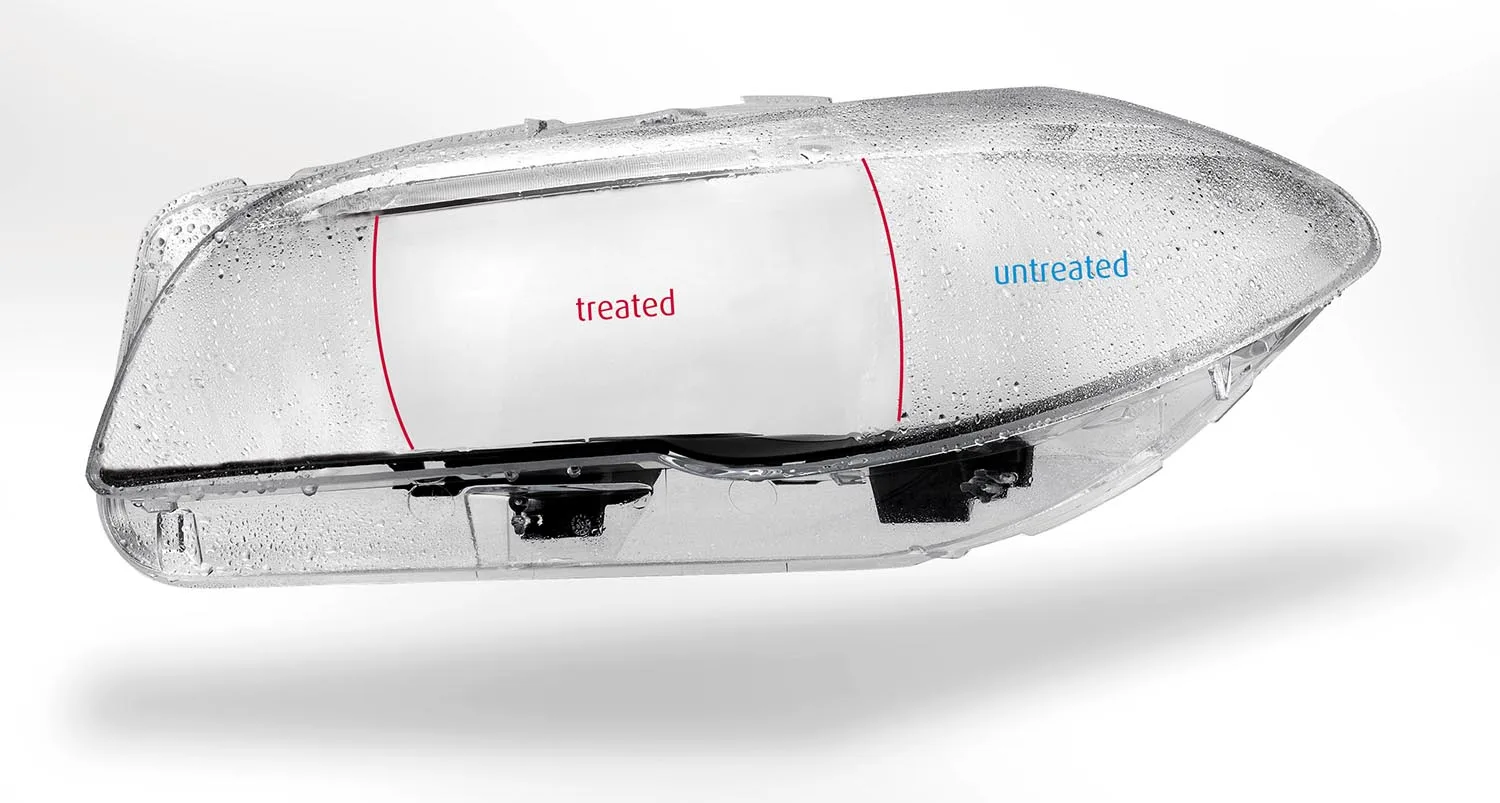
The Process: Automated Atmospheric Plasma nozzles, integrated directly into the robotic dispensing cell, generate high-energy ionized gas at normal room pressure. This plasma stream sweeps across the glass bonding track just seconds before the adhesive is applied, bombarding the material to remove nano-scale contaminants. This process increases surface energy and wettability, creating a highly cross-linked surface, leading to superior bonding capabilities in adhesives and coatings.

Source: Internet
The Chemistry: Since automotive glass is primarily composed of silicon dioxide (SiO2) – which is already an oxide – the goal of plasma is not to “remove oxide layers.” but to eliminate nano-scale organic carbon contamination. By utilizing ionized compressed air, or specialized dry gases like Nitrogen (N2) and Oxygen (O2), the highly reactive plasma stream instantly burns off invisible organic greases, airborne hydrocarbons, mold release agents; and breaks existing molecular bonds on the SiO2 structure, creating free radicals and highly reactive hydroxyl (-OH) groups.
Need specific advice on choosing the right equipment to better prepare glass surfaces for your assembly line?
Contact our technical experts here
The Result: The surface energy spikes dramatically (often from below 30 dynes/cm to over 72 dynes/cm). This guarantees the adhesive will achieve maximum “wet-out,” spreading flawlessly.

Source: Internet
Beside standard surface treatment, Prostech now has vacuum plasma treatment which is compatible for mass processing, especially in high-stakes industries like EV, Aerospace, Military, etc.

Source: Prostech
Watch our video with detailed information about this modern technology below.
Stage 3: Chemical Priming for Glass Surfaces Preparation in Automotive Manufacturing
For exterior automotive applications, this is the final, mandatory step to guarantee environmental durability throughout a vehicle lifespan.

Source: Prostech
The Process: Apply a highly controlled, thin layer of a Silane-based primer to the plasma-activated glass before dispensing the final structural adhesive. Not sure which primer to use yet? Register here for free consultation from our technical teams.
The Chemistry: Silane acts as a molecular bridge. One end bonds to the glass, and the other cross-links with the adhesive (normally Epoxy or Polyurethane).
The Result: The primer creates a permanent molecular bridge and acts as a hydrophobic (water-repelling) shield directly at the bond line, preventing road salt and washer fluids from causing catastrophic delamination.
Product Recommendations: Momentive Silquest A-174, Momentive Silquest A-187
Explore more information about formulation and priming processes to achieve maximum adhesion strength and durability here.
3. Adhesives Recommendation For Effective Glass Surfaces Preparation
A standard preparation protocol needs smart adhesive selection, which depends heavily on the automotive parts and their functions.
|
Application |
Recommended Adhesive |
Key Benefit After Glass Surfaces Preparation |
|
Windshields |
Structural Polyurethanes |
High elasticity and rapid handling strength for OEM lines. |
|
ADAS Sensors |
UV/Light Curable Acrylics |
Zero thermal distortion and optical precision (no outgassing). |
|
Headlight Sealing |
Silicones / MS Polymers |
Extreme thermal flexibility and waterproof IP67 sealing. |
3.1. Windshields & Panoramic Roofs: Structural Polyurethanes are recommended for three major reasons:
Vibration and Impact Absorption: Polyurethane (PU) adhesives possess high tensile strength combined with excellent elasticity, allowing them to absorb severe impacts and constant driving vibrations without compromising the bond between the heavy glass and the vehicle’s metal frame.
Structural Integrity & Non-Sag Properties: PU adhesives have a high-viscosity, non-sagging formula, meaning they can be applied to vertical windshield openings or overhead panoramic roofs without dripping or losing their shape before curing. Once cured, they are strong enough that no additional mechanical fixation is required.

Source: Internet
Rapid Handling Strength: These 1K or 2K moisture-curing formulas build extremely high initial green strength. This allows the heavy glass components to be rapidly assembled and moved down the OEM assembly line without slipping, drastically reducing cycle times.
Read more about Structural Adhesive here or find the most suitable Structural Polyurethanes Adhesive for your application here.
3.2. ADAS Sensors & Interior Displays: UV/Light Curable Acrylics are recommended for their optical clarity and instant curing, specifically:
Zero Thermal Distortion: UV-curable acrylics polymerize fully in a matter of seconds under UV or LED light at room temperature. This completely eliminates the need for heat-curing ovens, preventing thermal damage to highly heat-sensitive microchips and delicate display screens.
Optical Precision and Low Shrinkage: These adhesives exhibit exceptionally low shrinkage (as low as 0.4%) during the curing process. This dimensional stability guarantees that the exact focal alignment of high-resolution ADAS camera lenses remains perfectly intact after assembly.
No Outgassing: Premium UV acrylics used for optical systems produce no volatile compound outgassing. This is critical to ensure that interior displays and sensor cavities do not become fogged or contaminated, thereby maintaining absolute optical clarity.

Source: Internet
Using UV Curable Acrylics provide low-viscosity UV resin flows without trapping micro-bubbles, which are critical for parts requiring transparency and visibility in automotive designs.
Prostech provides comprehensive solutions for manufacturers, from adhesives, to dispensing and curing systems for UV Adhesives. Read more about UV Adhesive here or find the most suitable UV Curable Acrylics for your application here.
3.3. Headlight Sealing: Silicones / MS Polymers are recommended due to their flexibility, water, and vibration resistance.
Thermal Expansion Flexibility: Headlamp housings are subjected to extreme temperature fluctuations from both the internal bulbs and the external environment. Silicones act as Room-Temperature-Vulcanizing (RTV) sealants that easily adapt to the constant thermal expansion and contraction of differing materials (plastic to glass/metal) without cracking.

Source: Internet
Waterproof Sealing: They provide a highly durable, watertight barrier that completely seals the headlight housing, preventing rain and external moisture from leaking in and causing internal fogging or electrical shorts.
Vibration Resistance: The inherent flexibility of cured silicone reliably absorbs shock and vibrations from the engine compartment and rough roads, preventing the seal from degrading over the lifespan of the vehicle.
Read more about silicone here or find the most suitable Silicones / MS Polymers for your application here.
4. Prostech: Your Engineering Partner in Automotive Manufacturing
Selecting the right adhesive for glass bonding is only 50% of the engineering equation. The other 50% is process control. At Prostech, we provide B2B manufacturers with end-to-end solutions:
Process Validation: We do not guess. Our in-house laboratory analyzes your specific glass substrates (including coatings and frits) to design the exact cleaning, plasma, and priming protocol required.

Source: Prostech
Adhesive & Primer Matching: As authorized distributors for global chemical leaders (such as 3M, Henkel/Loctite, and Dymax), we pair the optimal industrial glass adhesive with its perfectly matched silane primer.
Automation Integration: To eliminate human error in glass surface preparation, we supply and integrate automated plasma treatment nozzles and precision primer/adhesive dispensing robots directly into your manufacturing line.
If the glass surfaces are not prepared correctly, even the most expensive PU or UV resin will fail.
Contact Prostech’s engineering team today for guide to prepare glass surfaces in Automotive Manufacturing and discover how the right surface preparation can drive your defect rate to zero.